February 11, 2008
In staging (the Washington DC part of training), Peace Corps tries to prepare you for arriving in country. I think it’s a noble cause but, let’s be honest, nothing prepares you for being in country. Regardless, before we left, I did get one piece of valuable advice that I still use today. The woman leading our hotel-conference room sessions told us, “Just open the door. Everyday, open the door.”
Now, I know this sounds simple when outside is your Starbuck’s cup of coffee, your car and, most importantly, hundreds of strangers who could care less that you left your house today. But, while living here, I’ve grown to miss these strangers. I miss not being cared about. I miss anonymity.
My walk to work everyday is pretty great. First, I leave my house and lock three doors on my way out. Getting out of “town” requires dodging various domestic animals, including guard dogs, whole flocks of chickens and the occasional goat. Then, I hop over the guardrail to the main road. The paved road! I love the paved road! And since it’s still dark and you can see for miles anyway, I walk a bit down the middle of the paved road just to reminisce. Then, I take a turn into the location. The first sign that I’m on time is the tractor warehouse guard unlocking the gate. The next sign is a middle-aged woman that I don’t know. Every morning she’ll say something like, “you are later today” or “Oh, you have woken early”. Thanks for the recognition, lady. Next is the boy who calls me teacher though he goes to a different school. “Good morning teacher.” Then, the check out girl from Multisave (our only grocery store in town) walks the other direction to work about this time. She knows I like oatmeal and don’t speak Damara (once I took a 4-year-old neighbor to Multisave with me. While I was paying the checkout girl seemed confused. Finally she stopped everything to ask if I was Damara and if the child was mine. I felt that “no” was the obvious answer but I didn’t want to say it so quickly that I insulted her intelligence, so I said “noooo” – which may have been too enthusiastic of a no). Next on the walk are the second grade girls who wave and stare – sometimes from the perch of trees. Then 25 minutes from when I locked my front door (17 when I book-it), I arrive in the safety of the school.
I got a ride to school this week in a hearse. A story for a different day, I think. But the next morning all of these people commented on my absence from the street the day before. Nice but, if it happened in America, creepy, no? Walking home is worse because, by then the town as resorted to its party-like atmosphere. Music blaring from houses. Women sitting under trees selling fat cakes. Kids on the stoop of the general store. Generally, I only get asked for a dollar once or twice. The “chief” tells me I changed the weather again. I say “Hello. I am fine. Thanks. And you?” about ten times. On special days, the street pastor will give me an impromptu lesson on spreading the good news and ask for my “viewings on the character of Jesus.” Also on these special days, the man who lives across from the hospital will yell, “Stop, stop walking! Stop! Stop walking! Stop! Talk! Stop walking!” until I am out of his sight. And, if I’m lucky, the fourth grader from the school in town will stop and ask me, with impressive neck-snapping attitude, my mother’s name, my father’s name and where I come from (her most rehearsed English phrases). Which is actually cute. Unlike the man across from the hospital.
On good days, this culture and life of Khorixas all make me smile on both walks. The fact that people are willing to talk to me and welcome me to their town makes me feel like maybe I will belong someday. On bad days, I feel like I am under a microscope (oil immersion 1000x). That’s when all the recognition makes me want to hide.
Luckily, hiding is easy because currently, I love my room. This is pretty pathetic seeing how my room is about the same size a drive thru Dutch Brothers. But it is mine and it is American. On it’s walls I have tacked every 2007 Christmas card, every going away card I brought with me, every letter written to me, my evaluation from modal school (my TRC PCV friend said some nice things. I need nice things in my life), a calendar from Grandma, a map of Namibia where I wrote all PCV sites, a world map (that convinces me the world is actually tiny and I can just hop back to you all), a Seattle space needle ornament left by the previous volunteer and glow in the dark stars (they’re so happy). So, as you can see, this is a nice hole to hide in. But sometimes I have to remind myself I am in Africa… I need to go outside and explore. I need to open the door.
Which bring me to the national anthem. Exploring Namibia makes you think of the national anthem and it would be a shame if I told you about explorations without sharing the background knowledge that goes with them. The anthem goes:
Namibia, Land of the brave
Freedom fight, we have won
Glory to their bravery
Whose blood waters our freedom
We give our love and loyalty
Together in unity
Contrasting, beautiful Namibia
Namibia our country
Beloved land
Of savannahs
Hold high the banner of liberty
Namibia, our country
Namibia, motherland, we love thee.
I’ve learned a couple of things from that anthem. First, the correct way to pronounce “our” is with a breath between its two syllables… that’s right two. Just like the word “films”. Second, apparently many nations are brave. And oddly it seems true for all of them. Striking out on your own and making a new country requires a bit of bravery, I would think. Third, the savannahs are the most loved. And, fourth, the line that will always get stuck in my head is the part about “contrasting, beautiful Namibia”.
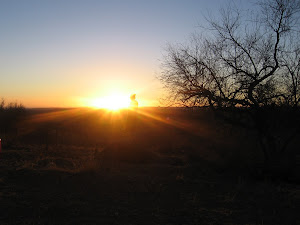
There’s nothing particularly musically interesting about that line. I think it just gets stuck in my head because it’s so true. My favorite example of contrast was on my walk this evening (the one where I forced myself to leave my Dutch brother’s room). Over the past few days, Khorixas has gotten more green than I thought possible. Nearly everywhere there was sand when I first arrived is covered in grass and little yellow flowers. The trees have doubled in size and grown leaves. As I was walking and enjoying the greenery, I couldn’t help but notice the sky. To the north was a rainbow in some white clouds and blue sky. To the west the sun was setting. Setting suns here always mean yellow, orange, pink, purple and perfect. To the south, over the donkerhoek was a downpour. It looked evil. To the East were dark purple clouds and lightening.
The whole thing made me think that maybe even the sky gets bored in Africa. And, land of contrast, it was beautiful and terrifying all at the same time. The rain was flooding the Donkerhoek. A little boy drowned in the rains there this weekend. It’s been an upset around town. He was very little and got carried away by a new-formed river (my learners were plastered to the windows facing the camp today during class because they wanted to see all the crowds and cameras who had come talk about the boy). And, in the same moments as the flood, a rainbow decorated the opposite sky. Thunder, lightening, sunset, flood and rainbow all at once seems like a crowd but, in Khorixas there was room in the sky for all of it.
Sometimes I think people make things up for national anthems. Ok, maybe not everyone is America is brave… or, maybe they weren’t really admiring the flag while enduring canon fire… (I know I wouldn’t have been). But, this is the long way of saying: For Namibia, it’s true. Beautiful and contrasting. They’re both true.
12-02-08
I had an odd sensation today. It was fleeting but all around odd anyway. It was a feeling that I was supposed to be here. I felt like, for a brief moment, that there wasn’t anywhere else in the world I was supposed to be.
At school we have eight periods in a day and one half hour tea break. A period is forty minutes long. At the end of each forty minutes one 7th grade boy is responsible for leaving all of his eight classes to ring the bell. I believe he was chosen for this task because of his upstanding nature… and, he owns a watch. Then, when the bell sounds, kids file out of class and move as a group (5A, 5B, 5C, 6A, 6B, 7A, or 7B) to their next classroom. The fun part of moving to another classroom is that transition time is not written into the schedule. First period ends at 8:00. Second period begins at 8:00. If 6A has to move from classroom 18 (the lowest numbered classroom – I don’t get it either) to classroom 42, they have to do it “quickly, quietly and efficiently” – nearly impossible for 40 6th graders. And, when they arrive at classroom 42 at 8:05, who is to blame? The class? The previous teacher? I don’t mind when my entire class arrives late. However, at times (at least once a day), a learner will arrive about 10 minutes after the rest of their class. I have yet to make this an offence that requires disciplinary action but, instead, stop them and ask “why are you late?” Here are some of the responses:
- “I was making food for Mr. [so and so].”
- “I was in the toilet.”
- “Mr. [so and so] was asking a stick.”
- “Miss [so and so] was asking tea.”
- “I was drinking the water.”
- “Mr. [so and so] sent me to the store for NikNaks (Namibian Cheetos)”.
- “I was lost.”
- “I have dropped my pen in the sand. Borrow me another.”
First, being in the toilet sounds messy… and wet. Second, English vocabulary is sometimes inserted into Afrikaans or KK grammar – it makes for interesting sentence structure. And, third, what the crap (am I allowed to say crap online)? I thought we were in school? I understand a learner being late for child-ish reasons like digging for their pen in the sand or getting lost at a school they’ve been attending since they were six years old. But being late to buy Cheetos? Being late to run to a teacher’s house and make a sandwich? I don’t know if I’ll ever get that.
Even outside of school, the whole concept is still foreign to me. Children run the errands and do the chores. They make and deliver tea and lunch. They clean the kitchen and do the dishes. They carry bags and water to the house. Is it just my imagination, or in America, is it the opposite? If I recall, in elementary school my mother made me lunch. I didn’t have to run home and make my entire family’s, my teacher’s and my lunch before running back to school.
They have a phrase here, though Americans use it more than Namibians (and I have to admit I’ve never heard it said by an American that wasn’t mocking). They say, “send a small boy.” Need a chair? Send a small boy. Need lunch? Send a small boy. Chalk? Small boy. Need another teacher? A small boy can tell them to come. We even learned “Axabrob” in KK class. It means “small boy”. This is what we call a cultural difference. I’m sure one of you can tell me the irreparable mental and physical damage we are doing to these small boys when they go to fetch this or that. I’m sure it’s against some child labor law. But, I have yet to decide which is a better system of raising a child. Granted, I love the way I was raised and, if I do say so myself, I turned out ok. But, that’s not the case for all American children. We’re spoiled. I was spoiled. Is that better or worse? I’m not sure. I am sure, though, science class is more important than NikNaks.
Oh, and “small boy” really just means child. Which really means learner. Which in our case could mean a 6 year old or 16 year old.
Tuesdays and Thursdays I teach for six of the eight periods. I have two double period math classes in the morning and two single period science classes in the afternoon. In order for me to teach these classes, I have to commandeer classrooms from other teachers who are off that period. I usually feel like an invasion force when I arrive at class. None of the teachers really know the schedule yet (myself included). So on their off periods they tend to be sitting quietly working at their desks a look up to see me standing their with an armload of teaching materials (that I could have let a small boy carry) and holding the schedule that says I get to take over their classroom. I’d like to think that my word is enough but it doesn’t hurt that I have the whole class I’m teaching behind me yelling things like “Miss [person in charge] said we are here!” Meanwhile, the ones who aren’t yelling are hitting each other over the head with something. Or eating something. Or stealing something. Or breaking something. (Kids… I do love them. I do.) I imagine most of these teachers are kind enough to give up their classrooms just to stop the chaos. And, I’m sure it has nothing to do with me looking like a homeless, beggar teacher.
If I were a real teacher, my double period math class would simply sit in the same classroom for two periods on Tuesday and Thursday. But, alas, I am a fake teacher. This means that on Tuesday and Thursday, I dedicate the last two minutes of the first period to prep my learners to switch classes. I tell them: “we are having the rest of class. You must go to room 42. Go in. Sit down. Get your exercise books out and keep working on your assignments.” So, after erasing any proof that I existed in the first classroom, I go to room 42 to find my learners standing outside hitting each other with something. Or eating something. Or stealing something. Or breaking something. I sigh. Then, I finagle my way into borrowing the classroom. Then, I call my learners in. They come in and stand there staring at me. This is common. It means we must greet each other. But, after I convince them that we did just spend forty minutes together, they finally sit down without a second greeting for the morning and, after a minimum of ten minutes and five reminders, get their books back out and open them. Kids… I do love them. I do.
Today, I was in the middle of finagling my class into their second classroom when one of my learners ran up to me with a worried look. She said, “kakerlaka.” I have learned the meaning of this word many times since I’ve been in Namibia – none of these lessons were pleasant. “Kakerlaka” means cockroach. She and her worried expression then bent down and flicked a cockroach away from my foot. Then she ran back to join the rest of her class. She saved me! She saved me from the kakerlaka! Granted, it was a cockroach and I’m pretty sure I could’ve handled myself if it had decided to take a path over my foot. But one of my learners was looking out for me. It made me feel accepted and I pondered for a brief moment adding cockroaches to international signs of peace but ultimately decided against it.
2-17-08
When I got home from work this Friday, I spent the afternoon cleaning to prepare for a couple of volunteers that were coming to town to spend the weekend. In mid-plunge, I wondered if ever before I had needed to plunge the toilet, bathtub, shower and kitchen sink to prepare for people staying the night – we have plumbing problems.
Yesterday was the Katmanjab-Khorixas cluster athletic competitions. Khorixas is the bigger town so the events were held at our stadium. There are two other education PCVs near Katmanjab who traveled with their learners this weekend. In theory, the games began at 7am on Saturday. We, who are learning precious integration skills, decided this merited us showing up at 8:45 – within two hours is appropriate. It was a good day overall. Though, I didn’t do anything I can claim will attribute to the betterment of the Namibia, the Peace Corps, Khorixas, my school, my learners or even these particular athletic games. However, I did get a lot of, what we like to call, “face time” – imperative in reminding your community that you still exist and, someday, when you’re not so clueless and they are actually in need of help (instead of the reverse), you will be there for them.
Spending the weekend with two other volunteers was nice because it gave me a little perspective on the whole PCV experience. I realized that, generally, we are all confused, all the time. It seems that, because you live in a certain town or remembered someone’s name, you may be a better PCV than another but, in actuality, it just means you are a better faker. More than once during the games, one of us would be talking to a local teacher or coordinator with the others standing silently by. At the end of an outwardly logical conversation, the two silent ones would ask, “What was that about?” Inevitably this was followed by, “I have absolutely no idea.”
I have this theory that if you just keep smiling and showing up maybe it’ll all work out. If nothing else, at least the American people seem pleasant because we smile all the time. Someone will say something like, “when the volunteers travel to Outjo they will train the team and ride with the learners.” This is followed by us smiling and saying, “okay…” while thinking “Me-volunteer or another volunteer? What team? What do I train them? Why are the learners going to Outjo? When? Are we going in the back of a cattle truck or a vehicle with seatbelts? What are we doing when we get to Outjo? Why did I need to know that?” And, in the time you are deciding which of these questions is the most pertinent to ask out loud (because there will only be time for one to be answered before another seemingly unrelated tangent will take place that only causes ten more questions), you smile.
2-18-08
I got a fever yesterday. It came on really fast in the afternoon. Just walking from the kitchen to my room felt like I had just run a lap around the track. Luckily, one of the times I collapsed from exhaustion after a walk through the house, it was next to my Peace Corps medical handbook. I decided this was probably the good time to make sure I didn’t have an exotic fever-causing virus only available in southwestern Africa.
It didn’t appear that I have anything more than a cold. But, still catching my breath (and still living in Namibia), I found some interesting things to read about in my handbook. My favorite section is the one completely dedicated to Culture Shock. Symptoms of culture shock were listed as: Homesickness, boredom, Family tension, Withdraw from friends, excessive amounts of sleep, compulsive eating or not eating, Irritability, stereotyping host country locals, loss of ability to work, inexplicable fits of weeping, exaggerated cleanliness, and alcohol abuse.
Jessica’s reading thoughts: “Fits of weeping? Check. Sleep? I sleep, yeah. Homesick? Check. Boredom? I’m still reading the PC medical handbook. Eat? Yeah… and I bake… is baking bad… Cleanliness? I take showers. Hmm.”
Keep reading: The stages of these symptoms follow the following pattern: 1) Initial euphoria 2) Irritability and hostility 3) Gradual adjustment 4) Adaptation and bi-culturalism
Jessica reading thoughts: “Cool. I get to be bi-cultural! Is that as cool as being bi-lingual? Wait, did I miss the euphoria? Was that somewhere between the jet-lag and break downs on the phone when I first called home?”
Suddenly, my low-grade fever was far from my thoughts and I was concerned with my mental state of being – as I often am in Namibia. Then, I got an SMS from a friend and got distracted – as I often do in Namibia. And forgot about the whole thing until later. At which point I decided: I may or may not have these symptoms. And I may or may not die of culture shock. But, either way, the fact remains that US government educational material continues to entertain me :)
Disclaimer: the above entry is a result of what I like to call a fever-medicine shadow. This means my brain was raised (granted, a few slight) degrees above normal and American medicine is strong and, well, both tend to make me ramble. Thanks for listening.
2-19-08
After spending some time in examination of the work done by the laborious dung beetle, I have a new appreciation for my lot in life and, if you spend your days involved in tasks other than rolling large pieces of…, you should too.
2-22-03
I think I’ve reached the point in the game where travel meets job. The novelty is officially starting to wear off.
I’ve reached a point where the beautiful African-child faces I teach everyday are the same learners I taught yesterday and will teach tomorrow. They need to do their homework and they need to tuck in their uniform shirt. Yes, you can go to the toilet. No, you may not throw a pen across the room.
I’ve reached a point where the crazy man on the corner who sells decorative nuts has about three with my name on them. Literally. And he’s impoverished… but I’m still not buying one. And I stopped feeling bad about saying no.
I’ve reached a point where stopping to talk to the woman who sits under the tree selling fat cakes is just stopping to talk to someone I know. Even though she gives me iffy medical advice like: “hold garlic on your tongue until it burns and then it will burn out the fever.” Hmm, I think I’ll stick to the fat cakes.
I’ve reached a point where I accept a ride from anyone with Khorixas plates. Don’t worry mom.
I’ve reached a point where Bird-sized moths are not fascinating. They are gross… ok and still pretty cool when they die and cover the road.
I’ve reached a point where I’ve quit caring that I don’t match. And I don’t notice that deodorant never comes out of my shirts. And I think I wore the same outfit on Wednesday and Friday this week… but I can’t be sure because I wear it so often.
I’ve reached a breaking point where I started wearing sunscreen. Hey, skin cancer never looked good on anyone.
I’ve reached a point where I nearly consistently remember that people at home are still at home and, thanks to technology, still very accessible. But I still get homesick. I think there’s no controlling that.
I’ve reached a point where I count down to seemingly mundane events. Wednesday: groceries! Woo! Saturday: Cinnamon rolls and Internet! Sweet! March 1st: new clothes that I haven’t worn in Namibia yet. I hid them from myself. I am going to be so clean! …Everybody needs a strategy for counting down the full two years.
I’ve reached a point where I can watch nearly a whole season of Grey’s Anatomy in 48 hours, while still going to work and sleeping. Ok, ok, I bet I could have done that before too.
I’ve reached a point where, when I see kids playing soccer in the street with a lightening storm in the background, I think of my childhood and not “oh, my goodness, I’m in Africa!” even when they yell “Donkey cart” instead of “car” to clear the game out of the street. (Actually, I have no idea what they yell because they aren’t speaking English, but something effectively gets them all out of traffic when it matters)
I think I’ve almost reached the point where this becomes normal.
Actually, I’m probably speaking too soon. But, there are enough normal moments in everyday to make me think that maybe, just maybe, the world is small. And maybe, we are all alike.
Don’t feel bad for me and my normality. Be proud. I may actually fit in soon. I may actually make a friend! …Lets not get carried though. I still only walk on two streets in the location and have been too scared to branch out. I’ll make it with time, though.
Wish me luck. I’m integrating.

Subscribe to:
Post Comments (Atom)

2 comments:
cockroach as the international symbol for peace. . .you make me laugh! But I totally appreciate the point and know how much it would mean to have this child reach out to you like that. SHE CARES!
You are amazing! So proud of you!
mom
There is a "direct to DVD" Stargate movie that comes out next Tuesday. I will rent it and watch it by myself.
Am I excited? Yes.
Post a Comment