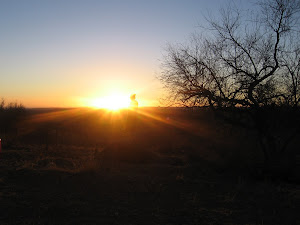
I keep reading online about record-breaking temperatures in the states. Here, it still feels a bit like winter today. Lucky for me, I have my sleeping bag to keep me warm. You know, I think that sleeping bags have a magical power. If you are feeling sick, or insecure, or tired and you slide into your sleeping bag you instantly feel better. It may only be my sleeping bag (which is falling apart at the seams now) but I have a theory that it works with any sleeping bag.
Life at school has just settled down for me. Last week was the Kunene regional science fair. We had big expectations for this year, given last year’s huge success and put a lot of work into our projects the weeks before the fair. The fair was held in Opuwo this year, so getting there and back was quite an adventure.
This past Friday morning, the 24th, I walked out into the hostel yard in the dark morning hours. Everything was quiet and my 6 science fair kids were nowhere to be seen. This aggravated me because I had told them over and over again not to be late. And to make matters worse, the hostel matron had promised us food for our journey and she was MIA. Two minutes after 6 AM a huge bus rolled into the hostel yard and started honking it’s horn. True to Namibian form, hundreds of kids appeared for a chance at excitement, my 6 among them. Suddenly, at my side was the matron with a box crammed with sandwiches and sausages. The wave of children ushered us onto the bus and we were gone to the regional science fair.
From Khorixas, it’s about a 4-hour drive to Opuwo. This Friday, it took us 9 hours. The bus was full – 4 learners to a three person seat. Snacks and soda being tossed around. A couple of secondary school boys were thrown off the bus for drinking alcohol. Pit stops were always in the bush, girls on the left, boys on the right. Who needs toilets?
By the time me and the other chaperones disembarked from the bus in Opuwo we were frazzled and ready for a break. Unfortunately, it wasn’t in the cards for us. A lot of the jobs I acquire in my life are because no one else wants them. I feel a bit of shame in this. But it’s become a repeating pattern in my life, so who am I to reject it now? Needless to say, the frazzled chaperones were gifted the jobs of science fair judge. Such power. Such influence. And no one else wanted the job.
There were about 9 altogether that got roped into the job of judge. We started our work almost immediately after stepping off the bus. A lot of the kids remembered me from judging last year. As it turned out, this year was much more fun than last year. I think it was because it was one of those few times I actually feel like I know what I’m doing here.
We stopped judging about 5 hours later and decided to finish the next morning. I spent the night at my fellow PCVs’ house (with a new and improved burglar bar door in place since the incident in March). And returned the next morning to finish judging. That morning, the last project I judged was on astronauts. The kids were really confident in all of their answers. Unfortunately, they were not correct in all their answers. For example, to the question, “Why do astronauts need space suits when they are in space?” they answered, “There are chemicals in space that will burn the person’s skin if they don’t have a suit.” To which I replied, “Are you sure? Is there another reason?” Answer, “Well, the chemicals and the strong winds will blow the astronaut away…” I could tell that my standards are lower because I was so impressed that they at least tried to answer the question. You see, the normal Nam-child response to a hard question is to stare and then cover your face with your hands until the questioning adult leaves. It’s so frustrating to have children shut down when you ask them a question. But the learners with the astronaut project were BSing! They were saying something! I gave them some points for confidence and finished up my tallies for the award ceremony that followed the fair.
This year, Eddie Bowe entered two grade 5 learners, Morris and Marimocha, who did a project about water purification. We entered two grade 6 learners, Losia and Kennedy, who won bronze in the National Science Fair last year in Windhoek. Their project was on plants. And we entered two grade seven learners, Sylvester and Mildredt, who did a fantastic project about gravity. I think grade 7’s project was my favorite – it was about air resistance and gravity. Losia and Kennedy, the two veterans, are great answering interviewing judges. They have confidence and they knew the answers to questions because they practiced, studied and prepared for the science fair. Grade 5 and grade 7, the four newbies, were very afraid to answer questions and were very timid and unsure while preparing in the weeks before the fair.
All the learners did great. However, confidence and experience prevailed and only two (Losia and Kennedy) out of six won an award. Losia and Kennedy got third place of all the primary school projects. They are going to National Science fair in Windhoek again this year! And I am proud of them.
After the award ceremony, I felt bad for the four Eddie Bowe learners who had expected so much and were walking away with nothing. They had tried. They spent a lot of time helping to make their board look beautiful but they were lacking in their ability to answer questions. More than once, I glanced over and saw my learners with their hands over their face and a judge impatiently waiting for a reply. Maybe next year they will have the skills to get further. It’s always a chance to get learn and grow.
The science fair and award ceremony were finished at 12:30 on Saturday afternoon. The kids were given a quick lunch and told to get on the bus. So, we got on the bus… Then, we did not make it back to Khorixas until 7pm on Sunday night. The only comfort in the complete tediousness of the bus was knowing that I will not have any problem reintegrating into American culture when I go home and this is why: I was so frustrated! Any American would be, right? But all of the other teachers on the bus didn’t seem to care that it took a day and a half to get home… there’s something to be said for a person who can integrate into another culture and make it their own… Unfortunately, I will never be that person. If only because I will never think it is ok for a 4-hour trip to take a day and a half… That’s all I’m saying :)
Wednesday, July 29, 2009

Sunday, June 14, 2009
Melodrama and Other Strange Things
Friday June 12, 2009
I was watching Long Way Down recently with Ewan McGregor and Charley Boorman. It’s a really great documentary where the two actors drive from Scotland to Cape Town on motorcycles. It’s really fun to see places I’ve been, mostly because documentaries make everything look so African and I’ve been there! Anyway, somewhere in central Africa, Ewan was watching a donkey cart drive by and got really excited. He said:
“I’m going to have the first donkey cart in North London. I’m going totally green. Never mind your Toyota Prius, I’m going donkey power!”
I appreciated his reaction to the cart because I watch donkey carts drive by all the time and I think the same thing. Except I’m not famous, so it doesn’t sound as cool. And, obviously, I’m not from North London.
Anyway, at the end of school today, I was frantically running around trying to finish up some scholarship applications for three of our very bright learners. I’m hoping they’ll get money to go into a good secondary school. It’s been very rewarding to work with these three learners and their families on these applications.
It’s very obvious that the people who live around me are poor. In fact, they’ll even tell you they’re poor. Or they’ll tell you that their hair is falling out and that they desperately need your food to help them. Only one slice of your bread… your apple… your money… your tea… will save this person, this learner, this child who’s come to your door without another place to turn, a victim of a cruel world – at least that’s how it’s presented to you as your being solicited. And these people aren’t wrong. They’re poor.
In contrast though, we have these three learners I’ve been working with this week. These learners have been a joy to work with because they have nothing. I mean nothing. But I never noticed until this week when I was scrambling to accumulate their financial records for this scholarship. I was scrambling to get this information because it does not exist. None of these learners’ parents have an income. And yet, everyday, without fail, all three of these learners can be found in class with a fresh face and a good attitude. None of them have asked me for food (more than once) and all of them are deeply respectful to everyone around them. They have no reason to be hopeful and yet they are. They have no inspiration around them to work hard, but they do. These three learners see something in the future that’s better than they’re current tin-shack life. What’s better is that their parents see it too. These kids’ parents are all so proud of their learners. They’re willing to help in whatever way possible and they’re excited that an opportunity exists.
I’m also glad that a scholarship exists in Namibia. Even if my learners don’t receive it, it’s nice to know that there is a hope for bright learners in dull situations. We all worked hard on these applications and now it’s time to cross our fingers and hope for the best.
Luckily, today is the beginning of a four-day weekend. Tuesday the 16th is the Day of the African Child. Which means No School Monday and Tuesday! WooHoo! So now it’s time to wind down for a long weekend of crosswords, reading and a small jaunt to Windhoek for a visit with Peace Corps and some other business.
Speaking of Peace Corps, one of the things that I like about PC is also one of the things I detest about Peace Corps and it is this: They give you entirely too much information. They give you information about how to dress, how to talk, how to sleep, how to eat, how to greet people, how to take medicine, how to sit, how to teach, how to travel, how to cope with emotions, how to put on a band-aid… on and on and on. So, it should not surprise you that I’ve also been briefed on how to write a blog post. The motto is this: Write blog posts on good days. Write journal entries on bad days.
I’ve held pretty true to form and usually only write blog posts on good days. Sometimes I write blog posts on bad days and see if I can make them sound good. Other times bad days are just funny – getting peed on by a goat? Funny. But mostly, I write about good days. Amazingly, I think that’s there’s been a pretty good representation of my experience here (obviously, it’s hard to relate everything. And I’m sure my blog would quickly become dull if I tried). I feel that you get the full experience – sunburns, terrible car rides and lame come-ons from creepy guys. But, at the same time, you don’t despair because you also get to experience adorable children, fun food and successful cross-cultural experiences too!
The reason I tell you all that is because I wrote a blog post on a bad day and I’m going to post it anyway. I’m going to post it in the spirit of getting the full experience. And because it’s a big deal in my life and this blog is to keep you up to date with big things that happen over here. I’m really enjoying my experience as a Peace Corps volunteer but I have to tell you it’s not all laughs and giggles and adorable children and funny cross cultural experiences. It’s real life. Just in Africa.
The section below, from June 9th, is still very pertinent in my life now. And it will probably be for some time to come. I’ve never been good at writing serious things – I always feel so melodramatic. But here you go.
Tuesday June 9, 2009
When I woke up on Monday morning, the power was out. I lit all the candles in the house (all easily accessible because the power outages aren’t that strange) and I was going about my morning routine. The only problem was that it was so quiet everywhere. Quiet inside for the lack of fans and computers. Quiet outside for the lack of children. And it was so dark and so cold too. It’s winter here now. It’s come in its full glory – shorter days, longer nights, cold toes, and foggy breath. I was standing over the sink, in the glow of candlelight brushing my teeth with icy water and I had the most surreal feeling. I didn’t know what time it was. Was it nighttime? Morning time? And more importantly, I didn’t know where I was. Or who I was. Or what I was doing here. And as all these doubts and questions came simultaneously into my silent bathroom, I had to hold my breath. I was afraid that if I started breathing again my reality, as I know it, would shatter. It was like all the images floating in front of my eyes weren’t real and if I thought about them too much they would vanish and I would be left with nothing.
Do you ever have that feeling? It’s always a risk to share something like that because sometimes people know exactly what you’re talking about. But other times, you get funny, sympathetic head tilts that confirm your worst fear: you’re crazy.
I know it seems like that’s out of left field, but it’s not. My friend died.
His name was Barry Kautuara. He was a teacher at my school. And he was my neighbor. I don’t usually write names of teachers in my blog. But you can trust me, if you’ve been reading my blog before, you’ve read about Barry. He was at every school event. He was always kind to me. Even before it was cool to be kind to the American. He was always out in the hostel yard ready to talk. He was always helpful and he would always take the time to explain things to me. But then, he would always take the time to listen to me too.
Our first day back to school this term (term 2 of the 3 in a year) was Tuesday March 26. We had our regular staff meeting that morning and we also had our regular staff prayer. It’s not uncommon for the prayer to be Damara. I just respectfully bow my head and consider it to be an extra minute or two that I can shut my eyes before the chaos of the day. When the prayer was finished on this morning, there was complete silence in the staff room. One woman was crying. Another got up and left the room. Silence. Days and nights of silence.
Finally, the principal cleared his throat and attempted to speak. He began, his voice cracked and then he began again, “Dear colleagues, I am also hearing this news at the same time you are hearing this new. One of our colleagues… one of our friends has passed away…” By this time my heart is in my throat. My head was frantically scanning the possibilities. And I am ashamed to say that in this small fraction of a second I comfortably assumed the unfortunate colleague was our dear, old, old social studies teacher who retired last year – it just made sense.
The principal began speaking again, “Mr. Kautuara was in a car accident traveling back after the break. It is a terrible loss…” I can’t be certain what was said next because by that time my brain was completely and utterly confused. I was absolutely sure that my principal had misspoken… Maybe Barry was in a car accident and now he’s in the hospital and he’ll be back to school later… maybe he meant to say one of the hundreds of other K surnames in Namibia: Kaiseb, Kariseb, Khais, Kameseb… I must have heard the principal wrong.
I came back to the conversations when the principal said, “Someone strong must tell the learners. I am not a strong person.” At this point, I was thankful – the news was about to be repeated to the learners. Everything would be said again in English during the school-wide assembly. For sure, this terrible mess would be made clear.
I am sorry to say that the news was repeated at assembly and it was the same. There was no change. There was no mistake. It was the same. And that this would be the beginning of my in-depth observations about the ways that Namibians handle death and the way an American handles the death of their Namibian friend.
I spent a lot of the past two weeks either offended by learners’ lack of respect for their late teacher, becoming closer to my colleagues through our shared mourning, completely confused or just plain heartbroken. That’s not to say that all learners were completely disrespectful. It’s just that 12, 13 and 14 year old minds aren’t always the most equipped to deal with death of a role model and mentor (which I am sure Barry was to many of these learners). At first, I was inclined to believe that the learners were being flippant about Barry because death is commonplace and, therefore, considered less important in Africa. I could not have been more wrong. In fact, I’m even shocked that I would let my mind wander there. Sure, there’s an AIDS epidemic. Sure, rural medical care is substandard and transport to hospitals is almost nonexistent. Sure, life is harder and shorter here. But when does the death of a father, mother, son, daughter, friend, or grandparent cease to take a toll on those who remain? I say, never.
But. Life has to continue. And it does. It hurts to move forward and it’s tragic to hold school the next day. It’s the worst thing in the world to dig through Barry’s desk looking for paperwork. And it’s awkward to tell learners to go to Mr. Kautuara’s class. I have to avoid looking into his classroom everyday – full of learners and no teacher (he was proud of his classroom and liked to keep it very neat. The learners have torn it apart since then).
My parents were still visiting when I first learned about Barry’s death. But when they left, it was doubly miserable and I felt very alone. Worst of the effects is that I am more afraid of transport in Namibia. I didn’t think it would be possible to become even more safety conscious than I already am. But it is. The only problem is that you can’t predict car accidents. They’re the worst kind of surprise.
Barry was Herero. I spend a lot of time with Damara people so I can’t be sure of the Herero tradition. But as I understand it, Hereros don’t like to keep bodies for too long. They must hold the funeral as soon as possible. For this reason, Barry’s funeral was on the weekend of the 29th. It was held by his family in a village outside of Okakarara. Our teachers asked for transportation from the Ministry of Education but our request was denied. Because of the long distance, our school sent a couple teachers as representatives for the school. They also took cards and letters to the family. Many people were distraught and completely outraged about being unable to attend the service. A few teachers were in tears as the Ministry explained that it wasn’t able to provide transport. And we all sat around for many hours trying to concoct an idea that would allow us to all go and pay our respects. But in the end, we could only afford to send those few teachers and that would have to be enough.
Since then, life has been a little off kilter. I find myself thinking about life and death quite a bit – the meaning of each and the reality that they both hold. My mind spends a lot of time dedicated to thoughts about religion and heaven and hell. I also think about what constitutes a true friendship considering the difference in cultures between Americans and Namibians. Often, I get stuck debating in my head when a death is about the mourners and when a death is about the departed. It’s harder to be the one left behind - my mom used to tell me, as a military brat watching my friends’ families pack up and move away. Maybe it’s true of death too. One things for sure though – I miss Barry.
I was watching Long Way Down recently with Ewan McGregor and Charley Boorman. It’s a really great documentary where the two actors drive from Scotland to Cape Town on motorcycles. It’s really fun to see places I’ve been, mostly because documentaries make everything look so African and I’ve been there! Anyway, somewhere in central Africa, Ewan was watching a donkey cart drive by and got really excited. He said:
“I’m going to have the first donkey cart in North London. I’m going totally green. Never mind your Toyota Prius, I’m going donkey power!”
I appreciated his reaction to the cart because I watch donkey carts drive by all the time and I think the same thing. Except I’m not famous, so it doesn’t sound as cool. And, obviously, I’m not from North London.
Anyway, at the end of school today, I was frantically running around trying to finish up some scholarship applications for three of our very bright learners. I’m hoping they’ll get money to go into a good secondary school. It’s been very rewarding to work with these three learners and their families on these applications.
It’s very obvious that the people who live around me are poor. In fact, they’ll even tell you they’re poor. Or they’ll tell you that their hair is falling out and that they desperately need your food to help them. Only one slice of your bread… your apple… your money… your tea… will save this person, this learner, this child who’s come to your door without another place to turn, a victim of a cruel world – at least that’s how it’s presented to you as your being solicited. And these people aren’t wrong. They’re poor.
In contrast though, we have these three learners I’ve been working with this week. These learners have been a joy to work with because they have nothing. I mean nothing. But I never noticed until this week when I was scrambling to accumulate their financial records for this scholarship. I was scrambling to get this information because it does not exist. None of these learners’ parents have an income. And yet, everyday, without fail, all three of these learners can be found in class with a fresh face and a good attitude. None of them have asked me for food (more than once) and all of them are deeply respectful to everyone around them. They have no reason to be hopeful and yet they are. They have no inspiration around them to work hard, but they do. These three learners see something in the future that’s better than they’re current tin-shack life. What’s better is that their parents see it too. These kids’ parents are all so proud of their learners. They’re willing to help in whatever way possible and they’re excited that an opportunity exists.
I’m also glad that a scholarship exists in Namibia. Even if my learners don’t receive it, it’s nice to know that there is a hope for bright learners in dull situations. We all worked hard on these applications and now it’s time to cross our fingers and hope for the best.
Luckily, today is the beginning of a four-day weekend. Tuesday the 16th is the Day of the African Child. Which means No School Monday and Tuesday! WooHoo! So now it’s time to wind down for a long weekend of crosswords, reading and a small jaunt to Windhoek for a visit with Peace Corps and some other business.
Speaking of Peace Corps, one of the things that I like about PC is also one of the things I detest about Peace Corps and it is this: They give you entirely too much information. They give you information about how to dress, how to talk, how to sleep, how to eat, how to greet people, how to take medicine, how to sit, how to teach, how to travel, how to cope with emotions, how to put on a band-aid… on and on and on. So, it should not surprise you that I’ve also been briefed on how to write a blog post. The motto is this: Write blog posts on good days. Write journal entries on bad days.
I’ve held pretty true to form and usually only write blog posts on good days. Sometimes I write blog posts on bad days and see if I can make them sound good. Other times bad days are just funny – getting peed on by a goat? Funny. But mostly, I write about good days. Amazingly, I think that’s there’s been a pretty good representation of my experience here (obviously, it’s hard to relate everything. And I’m sure my blog would quickly become dull if I tried). I feel that you get the full experience – sunburns, terrible car rides and lame come-ons from creepy guys. But, at the same time, you don’t despair because you also get to experience adorable children, fun food and successful cross-cultural experiences too!
The reason I tell you all that is because I wrote a blog post on a bad day and I’m going to post it anyway. I’m going to post it in the spirit of getting the full experience. And because it’s a big deal in my life and this blog is to keep you up to date with big things that happen over here. I’m really enjoying my experience as a Peace Corps volunteer but I have to tell you it’s not all laughs and giggles and adorable children and funny cross cultural experiences. It’s real life. Just in Africa.
The section below, from June 9th, is still very pertinent in my life now. And it will probably be for some time to come. I’ve never been good at writing serious things – I always feel so melodramatic. But here you go.
Tuesday June 9, 2009
When I woke up on Monday morning, the power was out. I lit all the candles in the house (all easily accessible because the power outages aren’t that strange) and I was going about my morning routine. The only problem was that it was so quiet everywhere. Quiet inside for the lack of fans and computers. Quiet outside for the lack of children. And it was so dark and so cold too. It’s winter here now. It’s come in its full glory – shorter days, longer nights, cold toes, and foggy breath. I was standing over the sink, in the glow of candlelight brushing my teeth with icy water and I had the most surreal feeling. I didn’t know what time it was. Was it nighttime? Morning time? And more importantly, I didn’t know where I was. Or who I was. Or what I was doing here. And as all these doubts and questions came simultaneously into my silent bathroom, I had to hold my breath. I was afraid that if I started breathing again my reality, as I know it, would shatter. It was like all the images floating in front of my eyes weren’t real and if I thought about them too much they would vanish and I would be left with nothing.
Do you ever have that feeling? It’s always a risk to share something like that because sometimes people know exactly what you’re talking about. But other times, you get funny, sympathetic head tilts that confirm your worst fear: you’re crazy.
I know it seems like that’s out of left field, but it’s not. My friend died.
His name was Barry Kautuara. He was a teacher at my school. And he was my neighbor. I don’t usually write names of teachers in my blog. But you can trust me, if you’ve been reading my blog before, you’ve read about Barry. He was at every school event. He was always kind to me. Even before it was cool to be kind to the American. He was always out in the hostel yard ready to talk. He was always helpful and he would always take the time to explain things to me. But then, he would always take the time to listen to me too.
Our first day back to school this term (term 2 of the 3 in a year) was Tuesday March 26. We had our regular staff meeting that morning and we also had our regular staff prayer. It’s not uncommon for the prayer to be Damara. I just respectfully bow my head and consider it to be an extra minute or two that I can shut my eyes before the chaos of the day. When the prayer was finished on this morning, there was complete silence in the staff room. One woman was crying. Another got up and left the room. Silence. Days and nights of silence.
Finally, the principal cleared his throat and attempted to speak. He began, his voice cracked and then he began again, “Dear colleagues, I am also hearing this news at the same time you are hearing this new. One of our colleagues… one of our friends has passed away…” By this time my heart is in my throat. My head was frantically scanning the possibilities. And I am ashamed to say that in this small fraction of a second I comfortably assumed the unfortunate colleague was our dear, old, old social studies teacher who retired last year – it just made sense.
The principal began speaking again, “Mr. Kautuara was in a car accident traveling back after the break. It is a terrible loss…” I can’t be certain what was said next because by that time my brain was completely and utterly confused. I was absolutely sure that my principal had misspoken… Maybe Barry was in a car accident and now he’s in the hospital and he’ll be back to school later… maybe he meant to say one of the hundreds of other K surnames in Namibia: Kaiseb, Kariseb, Khais, Kameseb… I must have heard the principal wrong.
I came back to the conversations when the principal said, “Someone strong must tell the learners. I am not a strong person.” At this point, I was thankful – the news was about to be repeated to the learners. Everything would be said again in English during the school-wide assembly. For sure, this terrible mess would be made clear.
I am sorry to say that the news was repeated at assembly and it was the same. There was no change. There was no mistake. It was the same. And that this would be the beginning of my in-depth observations about the ways that Namibians handle death and the way an American handles the death of their Namibian friend.
I spent a lot of the past two weeks either offended by learners’ lack of respect for their late teacher, becoming closer to my colleagues through our shared mourning, completely confused or just plain heartbroken. That’s not to say that all learners were completely disrespectful. It’s just that 12, 13 and 14 year old minds aren’t always the most equipped to deal with death of a role model and mentor (which I am sure Barry was to many of these learners). At first, I was inclined to believe that the learners were being flippant about Barry because death is commonplace and, therefore, considered less important in Africa. I could not have been more wrong. In fact, I’m even shocked that I would let my mind wander there. Sure, there’s an AIDS epidemic. Sure, rural medical care is substandard and transport to hospitals is almost nonexistent. Sure, life is harder and shorter here. But when does the death of a father, mother, son, daughter, friend, or grandparent cease to take a toll on those who remain? I say, never.
But. Life has to continue. And it does. It hurts to move forward and it’s tragic to hold school the next day. It’s the worst thing in the world to dig through Barry’s desk looking for paperwork. And it’s awkward to tell learners to go to Mr. Kautuara’s class. I have to avoid looking into his classroom everyday – full of learners and no teacher (he was proud of his classroom and liked to keep it very neat. The learners have torn it apart since then).
My parents were still visiting when I first learned about Barry’s death. But when they left, it was doubly miserable and I felt very alone. Worst of the effects is that I am more afraid of transport in Namibia. I didn’t think it would be possible to become even more safety conscious than I already am. But it is. The only problem is that you can’t predict car accidents. They’re the worst kind of surprise.
Barry was Herero. I spend a lot of time with Damara people so I can’t be sure of the Herero tradition. But as I understand it, Hereros don’t like to keep bodies for too long. They must hold the funeral as soon as possible. For this reason, Barry’s funeral was on the weekend of the 29th. It was held by his family in a village outside of Okakarara. Our teachers asked for transportation from the Ministry of Education but our request was denied. Because of the long distance, our school sent a couple teachers as representatives for the school. They also took cards and letters to the family. Many people were distraught and completely outraged about being unable to attend the service. A few teachers were in tears as the Ministry explained that it wasn’t able to provide transport. And we all sat around for many hours trying to concoct an idea that would allow us to all go and pay our respects. But in the end, we could only afford to send those few teachers and that would have to be enough.
Since then, life has been a little off kilter. I find myself thinking about life and death quite a bit – the meaning of each and the reality that they both hold. My mind spends a lot of time dedicated to thoughts about religion and heaven and hell. I also think about what constitutes a true friendship considering the difference in cultures between Americans and Namibians. Often, I get stuck debating in my head when a death is about the mourners and when a death is about the departed. It’s harder to be the one left behind - my mom used to tell me, as a military brat watching my friends’ families pack up and move away. Maybe it’s true of death too. One things for sure though – I miss Barry.
Friday, May 29, 2009
My mom and dad just visited from the states. They arrived on May 9th in Cape Town, South Africa. And they left today, about 30 minutes ago, from Windhoek, Namibia. So much has happened in the past few weeks that my head is still spinning. But while my mom was here, I asked her to write about her visit so that I could post it on my blog. Isn't it nice to have a fresh point of view? So, what follows is her blog post for me. And, no, in case you're wondering, I did not pay her to write all those nice things.
May 27, 2009
Namibia is wonderful. Yes, the country is beautiful – majestic mountains, savannahs rich in color, deserts that go on forever, the ocean and coast line – truly, Namibia lives up to its name the Land of Contrasts.
But one of my core beliefs is that the people make the place and I can say without hesitation that the Namibian people are amazingly friendly, gracious, intelligent and accepting. They are such lovely people.
We rented a car in Windhoek, a VW Polo. Its nice, but the steering wheel is on the right and we are driving on the left side of the road which is a story for another blog post. Stopping at petrol stations is a treat. There are 4 to 6 attendants and when they see us turn into the stations, one will claim our car and start waving us to them. So much energy and great customer service – Oregon gas station attendants (well, attendant since there is usually only 1) can take notice. But, here’s a difference between cultures, Kent would say “fill up with regular” and the attendant would smile and say “good morning. How are you?” So Kent would have to stop and say “good morning. I am fine. How are you?” After the greeting, THEN we could get gasoline, along with all of the windows washed, the air in the tires checked, as well as fluid levels under the hood – now THAT is customer service. To be fair to Kent, this only happened once. He is a fast learner and now is a great greeter. And Kent has adapted quickly to driving on the left side of the road as well as negotiating check points and chatting with guards.
We have driven a long way in our short time here. We traveled the southern border to the northern border, then to the eastern border and into Zambia to see Victoria Falls, then all the way to the west coast. We’ve seen so much – animals, cultures, architecture, art, vistas. . . that it would do a disservice to try to explain it all in a single blog post. But there is one thing here in Namibia I will tell you about, the one major goal of my trip, and that was to be with Jessica. SHE is truly amazing. Her blog posts, as wonderful as they are (isn’t she a great writer?), don’t tell half of the story. Her strength and ingenuity, the way she communicates with the people here, the respect she has for herself, the culture, the school and the learners have left me in total awe. People ask me all of the time if I worry about her being in Africa. And, you know, I really don’t. I worried more about her driving up and down I-5 between home and school than I do here. And now that I’ve seen her here for myself, I’m even more sure and comfortable that she is in her element. She understands life and how to make wise choices and how to roll with the punches. AND, most importantly, she knows how to laugh.
Jessica and Jill decided to have a braai (BBQ) for us on Wednesday night – our last night in town. Jill’s parents just arrived in town. So Jessica and Jill bought a goat. Actually they arranged with Ginno to buy a goat for them. Well, Ginno bought the goat the day we arrived in Khorixas which is 4 days before the braai. What does one do with a goat for 4 days? We have no pin. It can’t stay IN the flat with us. We can’t have it bleating for 4 days. SO Gino and his brother decided to slaughter the goat for us. Okay, good plan. Oh wait, what does one do with a slaughtered goat for 4 days? Jessica is the most resourceful person I’ve ever met. There was a moment of “OMG! I own a goat!” Then she started laughing at the situation while unpacking the small freezer she owns hoping a slaughtered goat will fit into the small compartment (it did). The actually slaughtering of the goat was not my favorite part of this trip, but the skill that Ginno’s brother showed was amazing. He is about 14 or 15 and very strong and knows his way around a goat. The payment for slaughtering a goat for someone is the innards and the head. I guess those are the best parts. I was asked if I ever ate goat intestines before. Apparently they are delicious. You know, I can honestly say that I have never been asked that question before, and I can honestly say that now and for every time in the future that I’m asked that question, the answer will be no.
So lets jump forward to Tuesday when it is time for us to take the frozen goat to have it sectioned at the local butchery shop. We could not get the goat or the container it was in out of the freezer. . . both were stuck. Kent took a knife and chopped the ice away from the edges to break the goat and container free. We were laughing at our situation. Then we drove into town to have the butcher cut the goat for us. But the goat was frozen to the container and wouldn’t budge. I’m pretty sure everyone in the butcher shop was laughing at us, but, oh well. We brought the goat home and left it on the kitchen floor to thaw. Then the electricity went out and we ended up sitting in candlelight and cell phone light with a frozen goat.
Cute side note: when the lights came back on we could hear the children in the dorms cheering. It was so adorable! I really love the children here.
The braai went off without a hitch. The food, meat and porridge, was delicious, children dancing, a soccer game on the TV, lots of people – a fun, fun party!
Kent, Jessica and I spent part of our time in Khorixas working on the library, Jessica’s library at the school. It is a nice place and you can see Jessica’s handiwork throughout the room with the way she has organized the books, instructions she has posted, the card catalog with cards in her handwriting for each learner. However, the walls were peeling and the room just needed some brightening. So I picked out some bright paint colors – grass green, ocean blue and a sunny yellow, and we cleaned and painted the walls. It turned out very nice. We stenciled designs on the walls and hung curtains. The curtains we bought are shetangays – cut pieces of cloth that have multiple purposes from clothing, to wall coverings, to curtains, to whatever you need it to be. The shetangays we bought are red with green, yellow and blue star bursts. All of the colors we choose are colors from the Namibia flag and each color represents a part of Namibia. So even though we tried to make it bright and fun, we kept it educational and meaningful to the learners. It was awesome watching the learners and teachers come into the library seeing it for the first time. I sat with some kids looking at Ranger Rick magazines, showed some of the girls how I painted the flowers in the room, and spent time with a world map showing some of the boys where I live in relation to Khorixas. It was so fun.
It will be hard to go back to Oregon. I love the way I feel here. My shoulders are loose here, my brain actually turns off at night, I can drink coffee without getting a sour stomach, I can sit and watch people, chickens, donkeys, goats, and/or scenery without having to do something else. . . this is all really good for me, a person who is constantly on the move multi-tasking. I hope to take this part of Namibia home with me. Well, that and about another thousand hugs from Jessica.
Mom's Blog Post
May 27, 2009
Namibia is wonderful. Yes, the country is beautiful – majestic mountains, savannahs rich in color, deserts that go on forever, the ocean and coast line – truly, Namibia lives up to its name the Land of Contrasts.
But one of my core beliefs is that the people make the place and I can say without hesitation that the Namibian people are amazingly friendly, gracious, intelligent and accepting. They are such lovely people.
We rented a car in Windhoek, a VW Polo. Its nice, but the steering wheel is on the right and we are driving on the left side of the road which is a story for another blog post. Stopping at petrol stations is a treat. There are 4 to 6 attendants and when they see us turn into the stations, one will claim our car and start waving us to them. So much energy and great customer service – Oregon gas station attendants (well, attendant since there is usually only 1) can take notice. But, here’s a difference between cultures, Kent would say “fill up with regular” and the attendant would smile and say “good morning. How are you?” So Kent would have to stop and say “good morning. I am fine. How are you?” After the greeting, THEN we could get gasoline, along with all of the windows washed, the air in the tires checked, as well as fluid levels under the hood – now THAT is customer service. To be fair to Kent, this only happened once. He is a fast learner and now is a great greeter. And Kent has adapted quickly to driving on the left side of the road as well as negotiating check points and chatting with guards.
We have driven a long way in our short time here. We traveled the southern border to the northern border, then to the eastern border and into Zambia to see Victoria Falls, then all the way to the west coast. We’ve seen so much – animals, cultures, architecture, art, vistas. . . that it would do a disservice to try to explain it all in a single blog post. But there is one thing here in Namibia I will tell you about, the one major goal of my trip, and that was to be with Jessica. SHE is truly amazing. Her blog posts, as wonderful as they are (isn’t she a great writer?), don’t tell half of the story. Her strength and ingenuity, the way she communicates with the people here, the respect she has for herself, the culture, the school and the learners have left me in total awe. People ask me all of the time if I worry about her being in Africa. And, you know, I really don’t. I worried more about her driving up and down I-5 between home and school than I do here. And now that I’ve seen her here for myself, I’m even more sure and comfortable that she is in her element. She understands life and how to make wise choices and how to roll with the punches. AND, most importantly, she knows how to laugh.
Jessica and Jill decided to have a braai (BBQ) for us on Wednesday night – our last night in town. Jill’s parents just arrived in town. So Jessica and Jill bought a goat. Actually they arranged with Ginno to buy a goat for them. Well, Ginno bought the goat the day we arrived in Khorixas which is 4 days before the braai. What does one do with a goat for 4 days? We have no pin. It can’t stay IN the flat with us. We can’t have it bleating for 4 days. SO Gino and his brother decided to slaughter the goat for us. Okay, good plan. Oh wait, what does one do with a slaughtered goat for 4 days? Jessica is the most resourceful person I’ve ever met. There was a moment of “OMG! I own a goat!” Then she started laughing at the situation while unpacking the small freezer she owns hoping a slaughtered goat will fit into the small compartment (it did). The actually slaughtering of the goat was not my favorite part of this trip, but the skill that Ginno’s brother showed was amazing. He is about 14 or 15 and very strong and knows his way around a goat. The payment for slaughtering a goat for someone is the innards and the head. I guess those are the best parts. I was asked if I ever ate goat intestines before. Apparently they are delicious. You know, I can honestly say that I have never been asked that question before, and I can honestly say that now and for every time in the future that I’m asked that question, the answer will be no.
So lets jump forward to Tuesday when it is time for us to take the frozen goat to have it sectioned at the local butchery shop. We could not get the goat or the container it was in out of the freezer. . . both were stuck. Kent took a knife and chopped the ice away from the edges to break the goat and container free. We were laughing at our situation. Then we drove into town to have the butcher cut the goat for us. But the goat was frozen to the container and wouldn’t budge. I’m pretty sure everyone in the butcher shop was laughing at us, but, oh well. We brought the goat home and left it on the kitchen floor to thaw. Then the electricity went out and we ended up sitting in candlelight and cell phone light with a frozen goat.
Cute side note: when the lights came back on we could hear the children in the dorms cheering. It was so adorable! I really love the children here.
The braai went off without a hitch. The food, meat and porridge, was delicious, children dancing, a soccer game on the TV, lots of people – a fun, fun party!
Kent, Jessica and I spent part of our time in Khorixas working on the library, Jessica’s library at the school. It is a nice place and you can see Jessica’s handiwork throughout the room with the way she has organized the books, instructions she has posted, the card catalog with cards in her handwriting for each learner. However, the walls were peeling and the room just needed some brightening. So I picked out some bright paint colors – grass green, ocean blue and a sunny yellow, and we cleaned and painted the walls. It turned out very nice. We stenciled designs on the walls and hung curtains. The curtains we bought are shetangays – cut pieces of cloth that have multiple purposes from clothing, to wall coverings, to curtains, to whatever you need it to be. The shetangays we bought are red with green, yellow and blue star bursts. All of the colors we choose are colors from the Namibia flag and each color represents a part of Namibia. So even though we tried to make it bright and fun, we kept it educational and meaningful to the learners. It was awesome watching the learners and teachers come into the library seeing it for the first time. I sat with some kids looking at Ranger Rick magazines, showed some of the girls how I painted the flowers in the room, and spent time with a world map showing some of the boys where I live in relation to Khorixas. It was so fun.
It will be hard to go back to Oregon. I love the way I feel here. My shoulders are loose here, my brain actually turns off at night, I can drink coffee without getting a sour stomach, I can sit and watch people, chickens, donkeys, goats, and/or scenery without having to do something else. . . this is all really good for me, a person who is constantly on the move multi-tasking. I hope to take this part of Namibia home with me. Well, that and about another thousand hugs from Jessica.
Friday, April 24, 2009
PHOTOS!!!! And other less important things.
April 20, 2009
I invigilated an end-of-the-term exam today. I teach every single one of the upper primary (grade 5 through 7) learners at my school now. At the beginning of class, Namibian tradition dictates that I should ask that class, “How are you, learners?” To which they will invariably answer, “We are fine, Miss. And how are you-oooOO?!” (Progressively getting higher and higher in pitch with the “you” that they just sound silly).
I think this tradition is stupid. If we do it so that they can practice English greetings, they need to move on, advance. If we do it so that I can gauge the emotional state of my class, they are all lying anyway and in the end, I know nothing (except that Morris has a strange ability to hit very high notes still).
Instead, I have developed a very technical system. I walk into a class and don’t have to say anything, and I know how every learner is feeling. It’s called The Thumbs Up System.
In The Thumbs Up System, I started by asking the learners, “How are you feeling today?” If they are feeling well (not “goodly”), they get to give a thumbs-up. If they are feeling badly, they get to give a thumbs-down. If they are feeling “somehow” (Namlish for average, blah, apathetic, etc.), they get to give a straight thumb. In my more advanced classed we also have 45degree thumb angles to signify somehow-good and somehow-bad.
The Thumbs Up System is so successful that I do not even have to ask them how they are feeling anymore. If I walk into a classroom on accident or while looking for someone, the whole class will throw me some kind of thumb sign. Some kids like to give me a thumbs-down and a big frown, then when I ask them what is wrong they laugh and turn their thumb up. Tricky tricky.
I lied though. It’s not called The Thumbs Up System. It’s not called anything. At least you know the truth. And I know the truth from the learners now too. The learners do not have to lie anymore. If they are not fine, they do not have to say that they are just for the sake of unity. And if they do not care how I am, they do not have to ask. It’s freedom. Just how we like it.
So, I invigilated this exam today. When I walk into the room, everyone gives me the thumbs up. It is really encouraging. Everyone is happy. All these thumbs up make me feel like I am approved of. Like maybe I am the cool teacher. I divide the exams among the learners, ask for quiet, please, and take a seat at the teacher’s desk. I was thankful to have such a cooperative group of learners to look after. They are concentrating, moving their mouths while reading questions, scratching their foreheads, trying to remember. I am flying through GRE flashcards (only a few weeks from my own exam now). We are the most productive room in the whole school. In all of Khorixas, in that moment.
Then, there is a squeal of joy. What?! I looked up from my cards. Every eye in the classroom was angled upwards. Hands and pencils still poised in test-taking mode. Everyone is frozen, not sure what to do next. Above our heads is a small bird flying, flying in circles. We’re all getting dizzy watching it. We are happy just to watch it for a while. Then the thought slowly comes to my head, we need to do something. We need to fix this. But how?
I look at the learners and, “Ahem”. I point my eyes downward towards their tests and they all reluctantly start to work on their tests again. We can hear the bird flapping above our heads. It is going faster now. Soon I realize that I am still staring at the bird. It is futile to try to not stare at the bird. At first the bird appears magical and free. It flaps it wings for half of the classroom and then soars the rest of the circle. It does not dip close to any of our heads. It is just here to say hello, maybe to wish us luck. It is not threatening.
Some learners are trying so very hard to keep their eyes on their exams. They look down and put their pencil to the paper. Then slowly, their eyes, almost involuntarily, turn back upward. When their thoughts return to their absentminded heads, they quickly look down at their exam again. They are losing time. They may not finish if this keeps up. I realize this and start to make plans in my head: We could all stand up and urge to bird out of the open door. We could try to throw a sweatshirt over the bird and carry it outside unharmed. We could… just then, one of the learners shows the bird a big thumbs-up… or we could tell the bird how we’re feeling.
None of us are getting anything done. The bird, at first wonderful and exciting, is getting more and more difficult to watch. We cannot take our eyes from it. But, where at first it was gliding and smooth, now it is floundering. It’s circles, at first perfectly geometric, are now irregular and incomplete. The bird is so so tired. It is looking for a way out. The windows are wide open and it does not see them. The door is free and clear and it just passes it by. Each time the bird pauses at a window, the classroom tenses it’s muscles. Then the bird continues on its wearied path and our hopes are dashed. It seems like there is no end in sight. Maybe this bird will just fall from the air, dead with exhaustion. Maybe it will free itself before anything drastic happens. Maybe… The bird lands on the chalkboard and readjusts itself so that it can stare at us all. It’s breathing hard and its eyes are pitch black. For a beat the classroom is silent. Then, like the opening of the stock market, the kids all remember their exams and start feverishly writing. Outside, they can see other children, from other classrooms, who have already finished their exams. The bell will ring soon.
I am thankful that the bird just sits there. It is still. It stares at me. I wonder if this will end up messy. Droppings on my head. Splatters on the window. We stare each other down. A dual. I wonder if the principal will let me go home and wash my hair… if the need somehow arises.
The learners are finishing their exams. Some of them have put their heads down. Some of them blow kisses to the bird on the chalkboard. I am thankful that it is still. A short while later, the bell rings. To my surprise, no one moves. Everyone just sits are stares at the bird. They are missing out the food and fun of break time. But they just sit there. Almost every eye in the classroom is on this small, pitiful bird. And as though it could sense the collective stare of 40 Namibian children, the bird reluctantly lifts itself into the air and resumes its circular path. Being free from their exams, the kids giggle and wave as the bird flies overhead. It tires faster this time and it becomes almost painful to watch it pause before windows and doors. It’s back hunches. It’s eyes become darker. We sit there for ten, maybe twenty, minutes. Circles and circles and more circles. At one point I remember that children like to catch birds here when they’re feeling extra hungry. Then they cook the tiny bodies over a fire made from donkey dung. I survey the classroom looking for learners who are drooling. There are none. Circles and circles and circles. And then, a charge. The bird backtracks and flies straight at my face. I panic and duck. The bird misses by and inch. It turns and swoops again, just over my head. Then, hovering by the door, it pauses. None of us believe it will leave. It is here to stay. A permanent fixture in the classroom. But, to our surprise, the bird pauses in front of the door, bows it’s head, as if to say goodbye, and ducks out the door. It’s gone.
“Yipppeeeee!” I hear from the back of the classroom. “Yipeeeeeeeeeeeeeeeeeee!” All the kids join in. They are imitating Grandpa Joe from Charlie and the Chocolate Factory. It’s adorable. I am happy that they are happy. I am happy to have avoided disaster. The learners collect their exams and turn them into me. Then, they file out of the classroom and disperse. But we are all bonded together. Stuck with this common experience.
Then, later, I went home. And, not having studied all that much while at school, I toss my GRE flashcards on the table and lay down – momentum is to blame. What to do? What to do? I’m bored. But I don’t want to study, too much brain energy. I know! I’ll write! I’ll write about that damn bird.
And here we are.
I can’t believe you read all that. :)
April 23, 2009
That last post, that was mean. I promise to never do that to you again. At least not intentionally. I’m sure I will write about pointless things again but will then think that they’re completely serious and interesting. I urge you not to tell me when they’re not interesting.
One of the more interesting things in my life, however, I will tell you about now. His name is Tu-o. Sometimes his name is Johannes. And occasionally it’s Kloefas. But if you ask him, he will say Tu-o. He is three years old and visits every Saturday morning when his mother comes to do the wash. Right now, he is my all-time favorite thing about Namibia.
Tu-o is my favorite because he is crazy. Not literally, but in practice. He is my favorite because he laughs like woody woodpecker. And he’s definitely my favorite because he’s never afraid. Sometimes during the week, my mind wanders and will end up at a memory of Tu-o from the previous weekend. Sometimes, in my memory, he’s trying to sneak up on me without being seen. If I turn my eyes even slightly in his direction he will bolt out the door where he is hidden again. Other times, in my memory, he’s lining up all his toys (that we let him borrow when he’s here) and then terrorizing them Godzilla-style. And sometimes, in my memory, he is wearing a silly Halloween costume sent from America, running around in circles and terrorizing his sisters, Emma and Katrina (one of my science fair stars from last year).
This last memory still makes me giggle out loud. At the time, it made me laugh so hard I was crying for half an hour straight. He is adorable. I hope you think so too:


I hoped you enjoyed that montage. I picture it to the tune of “Get Rhythm” by Johnny Cash – couldn’t tell you why though. It’s your lucky day though, because I’ll show you another picture montage. This one is of my outing for the Easter holiday. Before you look at them, though, you should know that they do not represent a normal volunteer life. The luxuries found below do not occur everyday. If they did, everyone would be rushing to be a Peace Corps volunteer. And then, it wouldn’t be called volunteering; it’d be called taking over another country… or something.
Also, the pictures are taken in a coastal town called Luderitz in the South of Namibia. It’s about 1200Km from Khorixas and took me about two days of crazy Nam-travel to get there (totally worth it). Lastly, you should know that I didn’t take any of the pictures (my camera was stolen in the previous blog post and, if I weren’t so lazy to write about it, I would tell you about how the police found it in this blog post. It was really amazing. They didn’t even use the footprints in the yard to find the 15 year old boys who were not even clever enough to leave Opuwo with 2 computers, American passports and wallets and a couple of digital cameras. So, the police easily found these youngsters and recovered our goods, minus my camera charger – a part of a camera you never really feel too attached too until it’s gone missing… No, I will not tell you that now). Please, do enjoy:
First, the two crazy days of travel to Luderitz involved a combi ride with, ahem, just the right number, er, the safe number of PCVs crammed in. This shows row 3, 4 and 5 in the combi. Let's not even talk about row 2.

That's my beautiful green eye that you can barely see in the back there.
 We stopped in the desert so that we could stretch our legs and honor the event by catching a photo with Flat Stanley for an elementary school in America


 Happy Easter!
I invigilated an end-of-the-term exam today. I teach every single one of the upper primary (grade 5 through 7) learners at my school now. At the beginning of class, Namibian tradition dictates that I should ask that class, “How are you, learners?” To which they will invariably answer, “We are fine, Miss. And how are you-oooOO?!” (Progressively getting higher and higher in pitch with the “you” that they just sound silly).
I think this tradition is stupid. If we do it so that they can practice English greetings, they need to move on, advance. If we do it so that I can gauge the emotional state of my class, they are all lying anyway and in the end, I know nothing (except that Morris has a strange ability to hit very high notes still).
Instead, I have developed a very technical system. I walk into a class and don’t have to say anything, and I know how every learner is feeling. It’s called The Thumbs Up System.
In The Thumbs Up System, I started by asking the learners, “How are you feeling today?” If they are feeling well (not “goodly”), they get to give a thumbs-up. If they are feeling badly, they get to give a thumbs-down. If they are feeling “somehow” (Namlish for average, blah, apathetic, etc.), they get to give a straight thumb. In my more advanced classed we also have 45degree thumb angles to signify somehow-good and somehow-bad.
The Thumbs Up System is so successful that I do not even have to ask them how they are feeling anymore. If I walk into a classroom on accident or while looking for someone, the whole class will throw me some kind of thumb sign. Some kids like to give me a thumbs-down and a big frown, then when I ask them what is wrong they laugh and turn their thumb up. Tricky tricky.
I lied though. It’s not called The Thumbs Up System. It’s not called anything. At least you know the truth. And I know the truth from the learners now too. The learners do not have to lie anymore. If they are not fine, they do not have to say that they are just for the sake of unity. And if they do not care how I am, they do not have to ask. It’s freedom. Just how we like it.
So, I invigilated this exam today. When I walk into the room, everyone gives me the thumbs up. It is really encouraging. Everyone is happy. All these thumbs up make me feel like I am approved of. Like maybe I am the cool teacher. I divide the exams among the learners, ask for quiet, please, and take a seat at the teacher’s desk. I was thankful to have such a cooperative group of learners to look after. They are concentrating, moving their mouths while reading questions, scratching their foreheads, trying to remember. I am flying through GRE flashcards (only a few weeks from my own exam now). We are the most productive room in the whole school. In all of Khorixas, in that moment.
Then, there is a squeal of joy. What?! I looked up from my cards. Every eye in the classroom was angled upwards. Hands and pencils still poised in test-taking mode. Everyone is frozen, not sure what to do next. Above our heads is a small bird flying, flying in circles. We’re all getting dizzy watching it. We are happy just to watch it for a while. Then the thought slowly comes to my head, we need to do something. We need to fix this. But how?
I look at the learners and, “Ahem”. I point my eyes downward towards their tests and they all reluctantly start to work on their tests again. We can hear the bird flapping above our heads. It is going faster now. Soon I realize that I am still staring at the bird. It is futile to try to not stare at the bird. At first the bird appears magical and free. It flaps it wings for half of the classroom and then soars the rest of the circle. It does not dip close to any of our heads. It is just here to say hello, maybe to wish us luck. It is not threatening.
Some learners are trying so very hard to keep their eyes on their exams. They look down and put their pencil to the paper. Then slowly, their eyes, almost involuntarily, turn back upward. When their thoughts return to their absentminded heads, they quickly look down at their exam again. They are losing time. They may not finish if this keeps up. I realize this and start to make plans in my head: We could all stand up and urge to bird out of the open door. We could try to throw a sweatshirt over the bird and carry it outside unharmed. We could… just then, one of the learners shows the bird a big thumbs-up… or we could tell the bird how we’re feeling.
None of us are getting anything done. The bird, at first wonderful and exciting, is getting more and more difficult to watch. We cannot take our eyes from it. But, where at first it was gliding and smooth, now it is floundering. It’s circles, at first perfectly geometric, are now irregular and incomplete. The bird is so so tired. It is looking for a way out. The windows are wide open and it does not see them. The door is free and clear and it just passes it by. Each time the bird pauses at a window, the classroom tenses it’s muscles. Then the bird continues on its wearied path and our hopes are dashed. It seems like there is no end in sight. Maybe this bird will just fall from the air, dead with exhaustion. Maybe it will free itself before anything drastic happens. Maybe… The bird lands on the chalkboard and readjusts itself so that it can stare at us all. It’s breathing hard and its eyes are pitch black. For a beat the classroom is silent. Then, like the opening of the stock market, the kids all remember their exams and start feverishly writing. Outside, they can see other children, from other classrooms, who have already finished their exams. The bell will ring soon.
I am thankful that the bird just sits there. It is still. It stares at me. I wonder if this will end up messy. Droppings on my head. Splatters on the window. We stare each other down. A dual. I wonder if the principal will let me go home and wash my hair… if the need somehow arises.
The learners are finishing their exams. Some of them have put their heads down. Some of them blow kisses to the bird on the chalkboard. I am thankful that it is still. A short while later, the bell rings. To my surprise, no one moves. Everyone just sits are stares at the bird. They are missing out the food and fun of break time. But they just sit there. Almost every eye in the classroom is on this small, pitiful bird. And as though it could sense the collective stare of 40 Namibian children, the bird reluctantly lifts itself into the air and resumes its circular path. Being free from their exams, the kids giggle and wave as the bird flies overhead. It tires faster this time and it becomes almost painful to watch it pause before windows and doors. It’s back hunches. It’s eyes become darker. We sit there for ten, maybe twenty, minutes. Circles and circles and more circles. At one point I remember that children like to catch birds here when they’re feeling extra hungry. Then they cook the tiny bodies over a fire made from donkey dung. I survey the classroom looking for learners who are drooling. There are none. Circles and circles and circles. And then, a charge. The bird backtracks and flies straight at my face. I panic and duck. The bird misses by and inch. It turns and swoops again, just over my head. Then, hovering by the door, it pauses. None of us believe it will leave. It is here to stay. A permanent fixture in the classroom. But, to our surprise, the bird pauses in front of the door, bows it’s head, as if to say goodbye, and ducks out the door. It’s gone.
“Yipppeeeee!” I hear from the back of the classroom. “Yipeeeeeeeeeeeeeeeeeee!” All the kids join in. They are imitating Grandpa Joe from Charlie and the Chocolate Factory. It’s adorable. I am happy that they are happy. I am happy to have avoided disaster. The learners collect their exams and turn them into me. Then, they file out of the classroom and disperse. But we are all bonded together. Stuck with this common experience.
Then, later, I went home. And, not having studied all that much while at school, I toss my GRE flashcards on the table and lay down – momentum is to blame. What to do? What to do? I’m bored. But I don’t want to study, too much brain energy. I know! I’ll write! I’ll write about that damn bird.
And here we are.
I can’t believe you read all that. :)
April 23, 2009
That last post, that was mean. I promise to never do that to you again. At least not intentionally. I’m sure I will write about pointless things again but will then think that they’re completely serious and interesting. I urge you not to tell me when they’re not interesting.
One of the more interesting things in my life, however, I will tell you about now. His name is Tu-o. Sometimes his name is Johannes. And occasionally it’s Kloefas. But if you ask him, he will say Tu-o. He is three years old and visits every Saturday morning when his mother comes to do the wash. Right now, he is my all-time favorite thing about Namibia.
Tu-o is my favorite because he is crazy. Not literally, but in practice. He is my favorite because he laughs like woody woodpecker. And he’s definitely my favorite because he’s never afraid. Sometimes during the week, my mind wanders and will end up at a memory of Tu-o from the previous weekend. Sometimes, in my memory, he’s trying to sneak up on me without being seen. If I turn my eyes even slightly in his direction he will bolt out the door where he is hidden again. Other times, in my memory, he’s lining up all his toys (that we let him borrow when he’s here) and then terrorizing them Godzilla-style. And sometimes, in my memory, he is wearing a silly Halloween costume sent from America, running around in circles and terrorizing his sisters, Emma and Katrina (one of my science fair stars from last year).
This last memory still makes me giggle out loud. At the time, it made me laugh so hard I was crying for half an hour straight. He is adorable. I hope you think so too:
I hoped you enjoyed that montage. I picture it to the tune of “Get Rhythm” by Johnny Cash – couldn’t tell you why though. It’s your lucky day though, because I’ll show you another picture montage. This one is of my outing for the Easter holiday. Before you look at them, though, you should know that they do not represent a normal volunteer life. The luxuries found below do not occur everyday. If they did, everyone would be rushing to be a Peace Corps volunteer. And then, it wouldn’t be called volunteering; it’d be called taking over another country… or something.
Also, the pictures are taken in a coastal town called Luderitz in the South of Namibia. It’s about 1200Km from Khorixas and took me about two days of crazy Nam-travel to get there (totally worth it). Lastly, you should know that I didn’t take any of the pictures (my camera was stolen in the previous blog post and, if I weren’t so lazy to write about it, I would tell you about how the police found it in this blog post. It was really amazing. They didn’t even use the footprints in the yard to find the 15 year old boys who were not even clever enough to leave Opuwo with 2 computers, American passports and wallets and a couple of digital cameras. So, the police easily found these youngsters and recovered our goods, minus my camera charger – a part of a camera you never really feel too attached too until it’s gone missing… No, I will not tell you that now). Please, do enjoy:
First, the two crazy days of travel to Luderitz involved a combi ride with, ahem, just the right number, er, the safe number of PCVs crammed in. This shows row 3, 4 and 5 in the combi. Let's not even talk about row 2.
That's my beautiful green eye that you can barely see in the back there.
We stopped in the desert so that we could stretch our legs and honor the event by catching a photo with Flat Stanley for an elementary school in AmericaWe visited the ghost town called Kolmanskop. Houses full of sand. Fantastic stories.
We went out on a sail boat. It was beeeaaauutiful. And cold. Very cold.
 We had a fantastic braii with lovely toasties (the process pictured below) (a toastie is a grilled cheese sandwich with any variety of other fillings).
And then everyone rejoiced!
Happy Easter!Next time, on The Elephant in the Middle of the Room, we'll see the brave parents conquering Namibia! Stay tuned.
Monday, March 23, 2009
“The Twenty Third of March oh-nine”
is what I would say if I were still normal
“Twenty THREE March two thousand and nine”
is what I say after a year and a half in Nam
I’m a little richer today. It’s nice being a little richer because yesterday I was a bit poorer.
I’m rich today because I got a package from mom. I’m ashamed to admit that I ate 3.5 servings of beef jerky for dinner tonight… but then again, America should be ashamed it sells things with 3.5 servings instead of 3 or 4.
And why was I a little poorer yesterday… well that’s a story we’ll have to start a week and a half ago. If you’ll permit a flashback, please:
“Eleven March”
The water went out about noon. I did everything I could not to think about it. Things have a tendency to work themselves out when you don’t think about them. I preoccupied myself with watching the entire second season of Heroes on my laptop instead. Then, afterwards, I spent some time trying to justify spending an entire afternoon watching a TV show. Then, I spent even more time being thankful that I have a job that lets me spend half a day watching TV trying not to think of something else. And even then, after all the thinking, justifying and TV watching, the water was still off.
To make things worse, we had a brownout at the same time. Luckily, my computer still charges in a brownout. But the downside was that poor little Ando, Hiro and Claire were stuck trying to distract me from two problems.
… I don’t think Peace Corps is what it used to be.
I went to bed trying not to think about water but also hoping that it would be on the next day.
“Twelve March”
The water came back on very late in the day. None of my Namibian coworkers were worried about the water at all though. I spent part of the afternoon study going from colleague to colleague at school to ask what had happened to the water. They all told me, “The water went out.” …I suppose I should’ve been more specific in my question asking.
I was impressed with myself though. In March last year, when the water was out for 6 hours I thought I was going to die. This year, it took about 25 hours before I started to get irritated. That’s a form of growth, right? I think my colleagues are up to about two days before they start to worry… Then again, maybe loosing the sense of water as “life-giving” and “necessary” is a bad thing.
Today I also sent my laundry to be cleaned by another woman. She ironed everything! I think even my underwear was ironed (ironing is a very big deal in Namibia). When she brought the laundry back, she asked for twice the normal price. It’s so frustrating to get treated like a white person after being here for so long. But, on the other hand, she did iron my underwear… and I didn’t have any water to do a better job… so, I ended up giving her one and a half the normal price. Plus, ironed clothes make me feel fancy.
“Fourteen March”
Yesterday morning, both my principal and supervisor announced in our morning staff meeting that they were leaving Khorixas to go out of town for various reasons. After the meeting I went to the library and started to work on some grading. As I was working, some water kept falling on my hands… I realized I was crying… why was I crying? It was because I wanted to leave too. I hadn’t left Khorixas for two months. I had to get out.
So I dried my eyes and went to my supervisor to see if she was still there. She was. She said she would wait for me to pack a bag and would take me with her. She and her husband bought me a cooldrink at the petrol station and drove me to Otjiwarongo. It was the happiest morning I’ve had in a while. From Otjiwarongo, I decided to visit the volunteers in Okakarara. I bought the things to make a pizza at Superspar and was lucky enough to find a taxi going to Okakarara with three passengers already (you always need 4 – any less and your driver won’t leave. Any more and you should probably protest and get out of the car. I’ve tried 8 in a car before. Unsafe? Yes. Uncomfortable? Hell yes.). We left right away.
I didn’t do much in Okakarara. We all just sat around, talking and eating. I came back to Khorixas today and felt a million times better just for having left. Strange how that works, huh?
“Seventeen March”
The water has been on and off since I got back from Okakarara on Saturday. Mostly off. Tonight it’s been out for 24 hours straight. Just a few drops before that. I went out in the hostel yard to ask around to see if anyone had water. No one did. Or, those who did didn’t want to share. The young Herero teachers who rent rooms next door were wandering around with buckets testing taps. They invited me to join. We found a small tap that was dripping water. They let me try to fill my bottle first. They didn’t get much after that. It went dry.
While I was out searching for water, Jill SMSed her friends in the location and in town. They’re all out of water too… it sounds like the hospital is the only place in all of Khorixas that has water. They have their own storage tower though. What is going on here?!
“Eighteen March”
The staff meeting at school this morning was comical. Women were wearing scarves over their dirty hair. One of the young men was begging around for some coffee or tea – “I can’t make it to even third period without coffee!” He’s my kind of addict.
Jill and I had a small bit of water left in our bucket. But most of our bottles for drinking were out of water. Dishes were everywhere and the toilet smelled and I’m out of clothes from the laundry woman last week. Gross.
My supervisor said that a friend drove from Outjo last night and explained that the main pipe to Khorixas was broken and all the water was flooding outside of town. It’s all hearsay. Jill heard different stories as she was walking around running errands in the morning. Maybe they were cleaning the holding tanks. Maybe the borehole went dry. The radio’s not broadcasting either, so no one knows the real reason for the drought.
Midday, Jill SMSed me and suggested we travel to Outjo and to visit Amanda. I was already home packing my bag when I got the SMS. Earlier in the month I had made plans to visit Opuwo on March 19-22 (the 20th is a school holiday to celebrate the 19th year of Namibian Independence). I decided that leaving a day earlier was acceptable - If only for the shower.
Jill and I asked all of our friend in Khorixas to SMS us with updates about the water. Then we headed to the petrol station where we used good old-fashioned positive thinking to find a ride. First person. Nice car. Air conditioning. Zero Dollars. Things were beginning to look up.
In Outjo, we did indeed get a shower and some food at the bakery. Just after lunchtime, we got an SMS from Khorixas saying the water at the hospital went dry. I’m beginning to worry about my little town. What will happen to all those people? It’s too hot to be without water.
Oprah-type list of things I’m thankful for today:
- Water!
- A shower.
- Water.
- Saltines at the Outjo grocery store.
- Water.
- A free ride out of Khorixas.
- H2O.
- That I don’t have to go back to Khorixas tomorrow.
“Nineteen March”
This morning I proceeded with my plans to go up to Opuwo for the long weekend. I spent about two hours sitting by the side of the road outside of Outjo. The only cars that stopped were going the wrong way or were the police. For some reason, the police took a keen interest in me this morning. Every ten minutes or so, they would stop and make sure everything was all right. Then, assured that I was OK, they would drive away, around the block and, ten minute later, back to me again. I told them my mother appreciated their concern. They laughed. But I was serious.
Someone finally picked me up at about 8:30am. He bought me breakfast and took me to Kamanjab. I knew we would be good friends when one of his first questions was:
“Do you want breakfast?”
I always want breakfast.
Then the second question:
“Do you use The Secret or positive thinking to get a lift?”
Um, those are the only ways to get a lift.
Anyway, along the way to Kamanjab he told me about his job. He works with rhino conservationists in Etosha. They are working on a project now to relocate some black rhinos to the south of Namibia. It was really great to hear about the camp where he works and I had tons of questions. Most of the time in hikes you have to feign interest. Example: “Oh, you sell cattle feed? Interesting. What’s the going price these days? Really. Who knew? Yeah, I love cattle feed too. Nothing better.” But in this hike I was totally interested in his work.
When he dropped me off at the Kamanjab petrol station he gave me his number and told me to call if I was in any trouble. He said the camp was only 60km away and he could come back and get me if there was a problem. For a second, I hmmed and I hawed and I kicked the dust and I did the math in my head. Finally I decided that finding a ride 60km outside of Kamanjab going to Opuwo wouldn’t be too hard at that hour in the day. So I asked the man if he would be willing to show me the camp. He said yes and we were on our way.
The rhinos were on the west side of Etosha. Only private tour operators and researchers are allowed on the west side of Etosha. The general public is only allowed to visit the east side. I felt very privileged as we passed the gates into the park. On the dirt road into the camp there were zebra, kudu, dikdik, orcs and giraffes. It was like a free safari!
When we reached the camp, the rhino experts gave me some tea and introduced me to 8 black rhinos that they had captured. My favorite rhino was princess Fiona. She was beautiful. Well, as beautiful as rhinos can be. I also appreciated that the rhinos spent part of their day listening to The Killers blaring from an ipod nearby. It’s strange where familiar things will pop up.
When I was finished meeting all the rhinos I was in total shock and in love with life. My hike drove me out to the main road going to Opuwo, filled my water bottle and dropped me on the side of the road. Only then did my head start to come back down to earth. I was thinking, “Oh, wow, that was totally awesome! Who gets to be that close to a wild rhino! Wow. Now I just have to find a ride from… from… where am I? Shoot. I’m in the middle of nowhere. Oh, gosh, nowhere, Africa. Shoot.” I felt safe though because I knew my rhino researches were nearby if I needed help. But, then, half an hour later my thoughts turned into, “Damn flies! Get off me. What?! The cell phone reception just went out again. Ugh” Then two hours later the skin on the top of my feet was radish-red and my thoughts were solely focused on getting a ride: “I hear a semi. Stop. Stop. Stop. Stop. For heaven sakes stop and pick me up. What? There’s a white person in the cab? What’s one more white person?! Pick me up! Aw, come on!” The semi had sped past me. But as I was cursing it and watching it go, it slowed to a stop and used a dirt driveway to pull a u-turn. When they rolled back to where I was standing, another Nam27 PCV was sitting the passenger’s seat. What were the chances? I guess we were just reinforcing the stereotype that all white people know all other white people.
The semi was only going another 60km toward Opuwo. It dropped the two of us at a tiny school in the middle of nowhere again. The work crew on the semi kept checking on us to make sure we were OK and I found myself feeling safe while standing in the middle of nowhere again. I love this country.
Almost immediately after getting out of the semi, a bakkie with a small family and four goats in the back stopped to pick us up. After agreeing to “hug the goats”, we hopped in. At first the situation was just comical. There was a cute, cuddly goat and a goofy goat and a dopey goat and a not-so-cute-cuddly goat. Then the cute, cuddly one peed on my foot. Then the not-so-cute-cuddly one started to eat my trousers. 120km later, I smelled like goat pee, was burnt to a crisp and not completely sure I could stand up.
When we pulled into Opuwo one of our Nam 27 friends met us at the petrol station to show us the way to his house. There are two PCVs in Opuwo. Four volunteers were visiting this weekend, including me. The volunteer house in Opuwo is a typical volunteer house – tin roof, burglar bars on the door and windows, buckets everywhere, a tiny Christmas tree, and 900 books. But it also has water and a beautiful view, so there is nowhere else I’d rather be tonight.
“Twenty March”
I can’t say we did anything too terribly exciting today. The two volunteers who stay in Opuwo still had to go to work. But the four of us who are visiting spent some time exploring Opuwo and shopping in the town. Opuwo is the regional head of Kunene. It’s an interesting town that’s full of Himba people and contradictions.
In the afternoon, we all gathered our swimming gear and trekked up to the Opuwo Country Lodge… or The Opuwo Country Hotel… or something to that effect. It sits on a hill just behind the volunteer house. When you reach the top of the hill, the lodge faces the opposite direction of Opuwo. It has a nice large patio for eating that overlooks an infinity pool and a beautiful valley below. We spent the afternoon there swimming and relaxing. We watched the sun go down and took a million pictures on all our cameras. It was a good day.
“Twenty Two March”
It was Namibia’s birthday yesterday. The country turned 19. To celebrate the holiday, the six of us decided to have a braii (BBQ). We went to the grocery store in town and bought all sorts of great things to cook – Chicken, sausage, onions, peppers, and potatoes. We got some firewood from the Himba outside and headed home.
We braiied for a few hours that afternoon. And when I say “we” I really mean that I watched and heartily participated in eating the product of all that hard work. It was a great afternoon. The weather was nice and some kids were playing soccer nearby. When we finished polishing off the food (except for one stubborn piece of uncooked chicken) everyone went inside to take a nap. I decided to stay on the porch and study for the GRE with some note cards I carried with me. I found myself people watching more than studying though. There were a lot of people walking by. Everyone was friendly. It was a nice afternoon.
That night, we decided that we would go out to a new-ish club in the area because one of the volunteers said it was a good place for dancing. We walked down to town and spent an hour or so just hanging out and meeting people. That was when one of the volunteers decided to go back to the house because he was tired. The rest of us went to another club nearby. This one had a disco ball. In my opinion, disco balls always mean trouble.
We were only at the second place for about ten minutes before one of us got an SMS that the volunteer house had been broken into. From the club, some local friends drove us to the house. When we pulled up, we could see that the burglar bar door on the front of the house was bent at the bottom just enough to allow for a small person, a child maybe. There was stuff on the porch – peanut butter, some clothes, rusks, an empty purse. When we walked into the front room, all of our bags had been overturned and completely rummaged through. We immediately went to our respective piles and started hoping that our things were still there. My passport! It was there. Under the socks. My money was gone! Only two hundred nam dollars, I could live with that. My debit cards were there! They were hidden by a small black pouch. Thank goodness. Ipod? Phone? They were still hidden in my sleeping bag. Sweet. I was almost off scot-free. But as much as I dug, I couldn’t find my camera.
It wasn’t until then that I started hearing what was going on around me. Cameras, wallets, two laptops (minus the power cords), debit cards, credit cards, keys, cash, a hard drive, that one stubborn piece of uncooked chicken from the braii and a tin can full of coins were all missing from the house. There was a large pile of things by the door. We could only assume that the small child who could fit through the bent burglar bar door was in charge of bringing an object to the door. If the adult at the door approved the item, it was taken. If the adult at the door refused the item, it was left in the pile. Maybe the bored adult was snacking on some peanut butter and rusks while they were waiting.
In my mind:
Child: How about this camera?
Adult: Yes, it has a lot of pictures of white people swimming at Opuwo lodge. Good.
Child: I found this computer
Adult: Of course! Those are worth money!
Child: How about this cord attached to it?
Adult: worthless
Child: But I think it’s for the electricity…
Adult: I said worthless! Now go get me some of that chicken from the stove.
Child: It’s not cooked
Adult: Even better.
Your mind goes strange places when you’re in stressful situations.
Who knows what really happened.
The next few hours we were on the phone with PC and talking to the Opuwo police. Just to entertain myself I went out to the front yard with the police when they were looking for a footprint. The police started ignoring my helpful suggestions after I had asked too many questions like, “What if the footprint is under the SUV you parked in the yard?” and “Doesn’t everyone buy their shoes at the same PEP store?” and “Don’t you need some kind of light to find a footprint?” One of them grunted at me to go back to the house. And I listened to them, went in the house and giggled the whole way. But Heaven knows that footprint would’ve saved us all.
After that, we stayed up for a few more hours making theories about how the whole thing went down. Was it someone we knew? They had to be waiting for us to leave the house because the whole thing was done in less than an hour. How did they know we were leaving? Was it one of the people passing by earlier in the day? Had we spent too much time altogether in town? That’s a lot of white people… It was a lot of thinking and speculating but in the end, we’ll never know.
To go to bed that night, we had to push the dining room table up against the door. It still locked, but it was bent and one set of keys was missing from the house. We all slept in the back of the house that night. No one wanted to be close to the door. Just after we turned off the lights, I heard a lot of movement… metal rattling maybe… lots of bumping… I kept telling myself, “It’s nothing, it’s nothing. If it’s something, someone else will hear it. It’s nothing.” But even though I told myself to be calm, my eyesight narrowed (a stupid side effect of fight or flight I decided in that moment) and my heart started pumping blood really hard. I was just about to say something to wake the others up when one of the volunteers busted out from his room to tell us that all the rest of his things were right where they were supposed to be. He had been moving things in his room. That was what I had heard. I really had to calm down before I got any sleep.
Early Sunday morning, I got an SMS that Jill had sent the day before. She said that the water was on in our flat (she had spent the weekend in Okakarara and had returned to Khorixas on Saturday). Even though I was only running on about three hours of sleep, I decided it was time to say goodbye to Opuwo and to my camera. I fuelled myself up with some of the rusks from the front porch and made my way down to the hike point for Khorixas. I got a ride almost immediately in a small bakkie crammed with people. There was a family of three in the bakkie that was also trying to find their way to Khorixas. They adopted me for the day. It was so nice to be adopted on that day. I needed someone to look out for me.
When the small bakkie made it to Kamanjab it let everyone out. When I went to pay the driver, he would not give me back all of my change. I was so angry but at the same time I thought, why not? Why not just take some extra?
I calmed down really quickly, though, when my adopted family for the day also got angry. Altogether, we couldn’t get the money back. So, instead they bought me a cooldrink and some lunch. One of the family members is a teacher at the primary school in Khorixas on the town side. We talked about teaching BIS while we flagged down cars outside of Kamanjab. The car we finally got drove with all the windows down on the dirt road so that when we reached Khorixas an hour later I was completely white. My orange backpack was completely white. My eyelashes had little drops of mud between them from the dust and tears that had mixed.
It was nice to be home. Jill gave a piece of chocolate cake. I took a bath. I saw my notice from the Post office for a package. I went to bed.
“Twenty Three March two thousand and nine”
I’m a little richer today. It’s nice being a little richer because yesterday I was a bit poorer.
I’m rich today because I got a package from mom. I’m ashamed to admit that I ate 3.5 servings of beef jerky for dinner tonight… but then again, America should be ashamed it sells things with 3.5 servings instead of 3 or 4.
is what I would say if I were still normal
“Twenty THREE March two thousand and nine”
is what I say after a year and a half in Nam
I’m a little richer today. It’s nice being a little richer because yesterday I was a bit poorer.
I’m rich today because I got a package from mom. I’m ashamed to admit that I ate 3.5 servings of beef jerky for dinner tonight… but then again, America should be ashamed it sells things with 3.5 servings instead of 3 or 4.
And why was I a little poorer yesterday… well that’s a story we’ll have to start a week and a half ago. If you’ll permit a flashback, please:
“Eleven March”
The water went out about noon. I did everything I could not to think about it. Things have a tendency to work themselves out when you don’t think about them. I preoccupied myself with watching the entire second season of Heroes on my laptop instead. Then, afterwards, I spent some time trying to justify spending an entire afternoon watching a TV show. Then, I spent even more time being thankful that I have a job that lets me spend half a day watching TV trying not to think of something else. And even then, after all the thinking, justifying and TV watching, the water was still off.
To make things worse, we had a brownout at the same time. Luckily, my computer still charges in a brownout. But the downside was that poor little Ando, Hiro and Claire were stuck trying to distract me from two problems.
… I don’t think Peace Corps is what it used to be.
I went to bed trying not to think about water but also hoping that it would be on the next day.
“Twelve March”
The water came back on very late in the day. None of my Namibian coworkers were worried about the water at all though. I spent part of the afternoon study going from colleague to colleague at school to ask what had happened to the water. They all told me, “The water went out.” …I suppose I should’ve been more specific in my question asking.
I was impressed with myself though. In March last year, when the water was out for 6 hours I thought I was going to die. This year, it took about 25 hours before I started to get irritated. That’s a form of growth, right? I think my colleagues are up to about two days before they start to worry… Then again, maybe loosing the sense of water as “life-giving” and “necessary” is a bad thing.
Today I also sent my laundry to be cleaned by another woman. She ironed everything! I think even my underwear was ironed (ironing is a very big deal in Namibia). When she brought the laundry back, she asked for twice the normal price. It’s so frustrating to get treated like a white person after being here for so long. But, on the other hand, she did iron my underwear… and I didn’t have any water to do a better job… so, I ended up giving her one and a half the normal price. Plus, ironed clothes make me feel fancy.
“Fourteen March”
Yesterday morning, both my principal and supervisor announced in our morning staff meeting that they were leaving Khorixas to go out of town for various reasons. After the meeting I went to the library and started to work on some grading. As I was working, some water kept falling on my hands… I realized I was crying… why was I crying? It was because I wanted to leave too. I hadn’t left Khorixas for two months. I had to get out.
So I dried my eyes and went to my supervisor to see if she was still there. She was. She said she would wait for me to pack a bag and would take me with her. She and her husband bought me a cooldrink at the petrol station and drove me to Otjiwarongo. It was the happiest morning I’ve had in a while. From Otjiwarongo, I decided to visit the volunteers in Okakarara. I bought the things to make a pizza at Superspar and was lucky enough to find a taxi going to Okakarara with three passengers already (you always need 4 – any less and your driver won’t leave. Any more and you should probably protest and get out of the car. I’ve tried 8 in a car before. Unsafe? Yes. Uncomfortable? Hell yes.). We left right away.
I didn’t do much in Okakarara. We all just sat around, talking and eating. I came back to Khorixas today and felt a million times better just for having left. Strange how that works, huh?
“Seventeen March”
The water has been on and off since I got back from Okakarara on Saturday. Mostly off. Tonight it’s been out for 24 hours straight. Just a few drops before that. I went out in the hostel yard to ask around to see if anyone had water. No one did. Or, those who did didn’t want to share. The young Herero teachers who rent rooms next door were wandering around with buckets testing taps. They invited me to join. We found a small tap that was dripping water. They let me try to fill my bottle first. They didn’t get much after that. It went dry.
While I was out searching for water, Jill SMSed her friends in the location and in town. They’re all out of water too… it sounds like the hospital is the only place in all of Khorixas that has water. They have their own storage tower though. What is going on here?!
“Eighteen March”
The staff meeting at school this morning was comical. Women were wearing scarves over their dirty hair. One of the young men was begging around for some coffee or tea – “I can’t make it to even third period without coffee!” He’s my kind of addict.
Jill and I had a small bit of water left in our bucket. But most of our bottles for drinking were out of water. Dishes were everywhere and the toilet smelled and I’m out of clothes from the laundry woman last week. Gross.
My supervisor said that a friend drove from Outjo last night and explained that the main pipe to Khorixas was broken and all the water was flooding outside of town. It’s all hearsay. Jill heard different stories as she was walking around running errands in the morning. Maybe they were cleaning the holding tanks. Maybe the borehole went dry. The radio’s not broadcasting either, so no one knows the real reason for the drought.
Midday, Jill SMSed me and suggested we travel to Outjo and to visit Amanda. I was already home packing my bag when I got the SMS. Earlier in the month I had made plans to visit Opuwo on March 19-22 (the 20th is a school holiday to celebrate the 19th year of Namibian Independence). I decided that leaving a day earlier was acceptable - If only for the shower.
Jill and I asked all of our friend in Khorixas to SMS us with updates about the water. Then we headed to the petrol station where we used good old-fashioned positive thinking to find a ride. First person. Nice car. Air conditioning. Zero Dollars. Things were beginning to look up.
In Outjo, we did indeed get a shower and some food at the bakery. Just after lunchtime, we got an SMS from Khorixas saying the water at the hospital went dry. I’m beginning to worry about my little town. What will happen to all those people? It’s too hot to be without water.
Oprah-type list of things I’m thankful for today:
- Water!
- A shower.
- Water.
- Saltines at the Outjo grocery store.
- Water.
- A free ride out of Khorixas.
- H2O.
- That I don’t have to go back to Khorixas tomorrow.
“Nineteen March”
This morning I proceeded with my plans to go up to Opuwo for the long weekend. I spent about two hours sitting by the side of the road outside of Outjo. The only cars that stopped were going the wrong way or were the police. For some reason, the police took a keen interest in me this morning. Every ten minutes or so, they would stop and make sure everything was all right. Then, assured that I was OK, they would drive away, around the block and, ten minute later, back to me again. I told them my mother appreciated their concern. They laughed. But I was serious.
Someone finally picked me up at about 8:30am. He bought me breakfast and took me to Kamanjab. I knew we would be good friends when one of his first questions was:
“Do you want breakfast?”
I always want breakfast.
Then the second question:
“Do you use The Secret or positive thinking to get a lift?”
Um, those are the only ways to get a lift.
Anyway, along the way to Kamanjab he told me about his job. He works with rhino conservationists in Etosha. They are working on a project now to relocate some black rhinos to the south of Namibia. It was really great to hear about the camp where he works and I had tons of questions. Most of the time in hikes you have to feign interest. Example: “Oh, you sell cattle feed? Interesting. What’s the going price these days? Really. Who knew? Yeah, I love cattle feed too. Nothing better.” But in this hike I was totally interested in his work.
When he dropped me off at the Kamanjab petrol station he gave me his number and told me to call if I was in any trouble. He said the camp was only 60km away and he could come back and get me if there was a problem. For a second, I hmmed and I hawed and I kicked the dust and I did the math in my head. Finally I decided that finding a ride 60km outside of Kamanjab going to Opuwo wouldn’t be too hard at that hour in the day. So I asked the man if he would be willing to show me the camp. He said yes and we were on our way.
The rhinos were on the west side of Etosha. Only private tour operators and researchers are allowed on the west side of Etosha. The general public is only allowed to visit the east side. I felt very privileged as we passed the gates into the park. On the dirt road into the camp there were zebra, kudu, dikdik, orcs and giraffes. It was like a free safari!
When we reached the camp, the rhino experts gave me some tea and introduced me to 8 black rhinos that they had captured. My favorite rhino was princess Fiona. She was beautiful. Well, as beautiful as rhinos can be. I also appreciated that the rhinos spent part of their day listening to The Killers blaring from an ipod nearby. It’s strange where familiar things will pop up.
When I was finished meeting all the rhinos I was in total shock and in love with life. My hike drove me out to the main road going to Opuwo, filled my water bottle and dropped me on the side of the road. Only then did my head start to come back down to earth. I was thinking, “Oh, wow, that was totally awesome! Who gets to be that close to a wild rhino! Wow. Now I just have to find a ride from… from… where am I? Shoot. I’m in the middle of nowhere. Oh, gosh, nowhere, Africa. Shoot.” I felt safe though because I knew my rhino researches were nearby if I needed help. But, then, half an hour later my thoughts turned into, “Damn flies! Get off me. What?! The cell phone reception just went out again. Ugh” Then two hours later the skin on the top of my feet was radish-red and my thoughts were solely focused on getting a ride: “I hear a semi. Stop. Stop. Stop. Stop. For heaven sakes stop and pick me up. What? There’s a white person in the cab? What’s one more white person?! Pick me up! Aw, come on!” The semi had sped past me. But as I was cursing it and watching it go, it slowed to a stop and used a dirt driveway to pull a u-turn. When they rolled back to where I was standing, another Nam27 PCV was sitting the passenger’s seat. What were the chances? I guess we were just reinforcing the stereotype that all white people know all other white people.
The semi was only going another 60km toward Opuwo. It dropped the two of us at a tiny school in the middle of nowhere again. The work crew on the semi kept checking on us to make sure we were OK and I found myself feeling safe while standing in the middle of nowhere again. I love this country.
Almost immediately after getting out of the semi, a bakkie with a small family and four goats in the back stopped to pick us up. After agreeing to “hug the goats”, we hopped in. At first the situation was just comical. There was a cute, cuddly goat and a goofy goat and a dopey goat and a not-so-cute-cuddly goat. Then the cute, cuddly one peed on my foot. Then the not-so-cute-cuddly one started to eat my trousers. 120km later, I smelled like goat pee, was burnt to a crisp and not completely sure I could stand up.
When we pulled into Opuwo one of our Nam 27 friends met us at the petrol station to show us the way to his house. There are two PCVs in Opuwo. Four volunteers were visiting this weekend, including me. The volunteer house in Opuwo is a typical volunteer house – tin roof, burglar bars on the door and windows, buckets everywhere, a tiny Christmas tree, and 900 books. But it also has water and a beautiful view, so there is nowhere else I’d rather be tonight.
“Twenty March”
I can’t say we did anything too terribly exciting today. The two volunteers who stay in Opuwo still had to go to work. But the four of us who are visiting spent some time exploring Opuwo and shopping in the town. Opuwo is the regional head of Kunene. It’s an interesting town that’s full of Himba people and contradictions.
In the afternoon, we all gathered our swimming gear and trekked up to the Opuwo Country Lodge… or The Opuwo Country Hotel… or something to that effect. It sits on a hill just behind the volunteer house. When you reach the top of the hill, the lodge faces the opposite direction of Opuwo. It has a nice large patio for eating that overlooks an infinity pool and a beautiful valley below. We spent the afternoon there swimming and relaxing. We watched the sun go down and took a million pictures on all our cameras. It was a good day.
“Twenty Two March”
It was Namibia’s birthday yesterday. The country turned 19. To celebrate the holiday, the six of us decided to have a braii (BBQ). We went to the grocery store in town and bought all sorts of great things to cook – Chicken, sausage, onions, peppers, and potatoes. We got some firewood from the Himba outside and headed home.
We braiied for a few hours that afternoon. And when I say “we” I really mean that I watched and heartily participated in eating the product of all that hard work. It was a great afternoon. The weather was nice and some kids were playing soccer nearby. When we finished polishing off the food (except for one stubborn piece of uncooked chicken) everyone went inside to take a nap. I decided to stay on the porch and study for the GRE with some note cards I carried with me. I found myself people watching more than studying though. There were a lot of people walking by. Everyone was friendly. It was a nice afternoon.
That night, we decided that we would go out to a new-ish club in the area because one of the volunteers said it was a good place for dancing. We walked down to town and spent an hour or so just hanging out and meeting people. That was when one of the volunteers decided to go back to the house because he was tired. The rest of us went to another club nearby. This one had a disco ball. In my opinion, disco balls always mean trouble.
We were only at the second place for about ten minutes before one of us got an SMS that the volunteer house had been broken into. From the club, some local friends drove us to the house. When we pulled up, we could see that the burglar bar door on the front of the house was bent at the bottom just enough to allow for a small person, a child maybe. There was stuff on the porch – peanut butter, some clothes, rusks, an empty purse. When we walked into the front room, all of our bags had been overturned and completely rummaged through. We immediately went to our respective piles and started hoping that our things were still there. My passport! It was there. Under the socks. My money was gone! Only two hundred nam dollars, I could live with that. My debit cards were there! They were hidden by a small black pouch. Thank goodness. Ipod? Phone? They were still hidden in my sleeping bag. Sweet. I was almost off scot-free. But as much as I dug, I couldn’t find my camera.
It wasn’t until then that I started hearing what was going on around me. Cameras, wallets, two laptops (minus the power cords), debit cards, credit cards, keys, cash, a hard drive, that one stubborn piece of uncooked chicken from the braii and a tin can full of coins were all missing from the house. There was a large pile of things by the door. We could only assume that the small child who could fit through the bent burglar bar door was in charge of bringing an object to the door. If the adult at the door approved the item, it was taken. If the adult at the door refused the item, it was left in the pile. Maybe the bored adult was snacking on some peanut butter and rusks while they were waiting.
In my mind:
Child: How about this camera?
Adult: Yes, it has a lot of pictures of white people swimming at Opuwo lodge. Good.
Child: I found this computer
Adult: Of course! Those are worth money!
Child: How about this cord attached to it?
Adult: worthless
Child: But I think it’s for the electricity…
Adult: I said worthless! Now go get me some of that chicken from the stove.
Child: It’s not cooked
Adult: Even better.
Your mind goes strange places when you’re in stressful situations.
Who knows what really happened.
The next few hours we were on the phone with PC and talking to the Opuwo police. Just to entertain myself I went out to the front yard with the police when they were looking for a footprint. The police started ignoring my helpful suggestions after I had asked too many questions like, “What if the footprint is under the SUV you parked in the yard?” and “Doesn’t everyone buy their shoes at the same PEP store?” and “Don’t you need some kind of light to find a footprint?” One of them grunted at me to go back to the house. And I listened to them, went in the house and giggled the whole way. But Heaven knows that footprint would’ve saved us all.
After that, we stayed up for a few more hours making theories about how the whole thing went down. Was it someone we knew? They had to be waiting for us to leave the house because the whole thing was done in less than an hour. How did they know we were leaving? Was it one of the people passing by earlier in the day? Had we spent too much time altogether in town? That’s a lot of white people… It was a lot of thinking and speculating but in the end, we’ll never know.
To go to bed that night, we had to push the dining room table up against the door. It still locked, but it was bent and one set of keys was missing from the house. We all slept in the back of the house that night. No one wanted to be close to the door. Just after we turned off the lights, I heard a lot of movement… metal rattling maybe… lots of bumping… I kept telling myself, “It’s nothing, it’s nothing. If it’s something, someone else will hear it. It’s nothing.” But even though I told myself to be calm, my eyesight narrowed (a stupid side effect of fight or flight I decided in that moment) and my heart started pumping blood really hard. I was just about to say something to wake the others up when one of the volunteers busted out from his room to tell us that all the rest of his things were right where they were supposed to be. He had been moving things in his room. That was what I had heard. I really had to calm down before I got any sleep.
Early Sunday morning, I got an SMS that Jill had sent the day before. She said that the water was on in our flat (she had spent the weekend in Okakarara and had returned to Khorixas on Saturday). Even though I was only running on about three hours of sleep, I decided it was time to say goodbye to Opuwo and to my camera. I fuelled myself up with some of the rusks from the front porch and made my way down to the hike point for Khorixas. I got a ride almost immediately in a small bakkie crammed with people. There was a family of three in the bakkie that was also trying to find their way to Khorixas. They adopted me for the day. It was so nice to be adopted on that day. I needed someone to look out for me.
When the small bakkie made it to Kamanjab it let everyone out. When I went to pay the driver, he would not give me back all of my change. I was so angry but at the same time I thought, why not? Why not just take some extra?
I calmed down really quickly, though, when my adopted family for the day also got angry. Altogether, we couldn’t get the money back. So, instead they bought me a cooldrink and some lunch. One of the family members is a teacher at the primary school in Khorixas on the town side. We talked about teaching BIS while we flagged down cars outside of Kamanjab. The car we finally got drove with all the windows down on the dirt road so that when we reached Khorixas an hour later I was completely white. My orange backpack was completely white. My eyelashes had little drops of mud between them from the dust and tears that had mixed.
It was nice to be home. Jill gave a piece of chocolate cake. I took a bath. I saw my notice from the Post office for a package. I went to bed.
“Twenty Three March two thousand and nine”
I’m a little richer today. It’s nice being a little richer because yesterday I was a bit poorer.
I’m rich today because I got a package from mom. I’m ashamed to admit that I ate 3.5 servings of beef jerky for dinner tonight… but then again, America should be ashamed it sells things with 3.5 servings instead of 3 or 4.
Friday, March 13, 2009
It stopped raining on March 7. I get to keep my Namdollar.
25 February
When we started Peace Corps, I heard a few times, “Non-readers will become readers. Readers will become writers”. This was in reference to how bored and lonely you get while sitting alone in your new empty home and the means by which you entertain yourself. At first, I thought, “whoa, I was a reader and now I’m becoming a writer.” But I was wrong. I wasn’t a reader. And I definitely wasn’t becoming a writer. In fact, I don’t know if I have any new scholastic habit. I do read more. But I think that’s because I have the time. Still, 50 pages is my limit for a day before my brain starts to itch and I have to put the book down for something more “productive”, like sweeping an already clean floor or washing a shirt that’s only been worn once.
Anyway, I’ve been thinking about this idea of reading. In schools here, you hear the term “reading culture” thrown around. And example sentence is: “we want to make the library a nice place to encourage a reading culture.” Maybe this is a common phrase, or maybe my school coined it… but I doubt it. So, I’ve been wondering, what is a reading culture? And why is it our big goal?
I think that we do have a reading culture in America. All of our history is written down. The number of times I remember my grandmother talking about her mother and father I can count on two hands (I imagine it’s probably one hand worth of fingers for most people my age. I just get to use two hands because that side of my family enjoys genealogies… but that’s beside the point). Most grandparents don’t sit down and recite history to their bouncing America baby. No, you send them off to school, where they learn all those good things from books.
Sometimes when I hear the phrase “reading culture”, I automatically imagine a person with trendy glasses, sitting in a coffee shop window, wearing skinny jeans and a pointless scarf, reading “Catch 22” or “The Kite Runner” or “Middlesex” or some other book that really makes them think about the meaning of life…. But more importantly, makes them able to relate, on some level, to the thousands of other people who’ve read that book.
I know that Americans don’t read entirely to look trendy. But you can’t deny that books sure don’t hurt your indie hipster image. I also know that American parents don’t send their kids off to school so they can be free from the obligations of teaching their children about the world and all the cool things in it. If that were true, I would have spent a lot fewer nights in a tent in the middle of the wood as a child.
I always think back to America first because it’s what I know but also because it’s the model for other countries. Good or bad, it’s true. I’ve been told English was perfected in America. I wanted to say, Aw, brutha, ya kno that ain’t tru. But it may very well be.
I think our school is just looking for a standard. At least I hope that’s what they’re looking for. There’s a common knowledge that exists here in Khorixas. I always feel like I’ve cracked a secret code when I learn a little tidbit of it. For example, we had some friends over at the end of last year. They told us about all of the tribes in our area. Just Damara, Right? Wrong. There are different tribes of Damara! Granted, I can’t pronounce a single one of them. But the omas and opas (grandmas and grandpas) know which tribe they’re from. Our visitors told us that the omas and opas can tell the difference between people from each of the Damara tribes (I can’t even tell the difference between the general Namibian tribes, unless I hear them speaking). But then, just a few weeks ago, I was reading through the social studies books. I didn’t see one mention of Damara tribes. Everyone knows about them, but you can’t read about them. If I asked 5 different people: “How many tribes are there? Where did they live? What are their names?” I would get a huge variety of answers.
A second example: I’ve heard 4 different stories now about how Khorixas came to be Damaraland. They’ve all been on hitchhikes when the driver feels inclined for a history lesson. But does anyone really know? Did anyone write it down? The answer is yes, but no one here reads it.
Which brings me to the reading culture. Do we really need it? I mean books can be just as jaded as an oma sitting by the fire spinning a yarn about the glory days. But then, in print, they influence more people. Is that good? Or is that bad?
I don’t know. I don’t have an answer for you. I’m just thinking. And I’m just doing my job, which is reading. And by golly, do we read. I’ve got about 320 learners in all of my classes and about 200 hundred of them have books in their hands tonight. Some of them may be looking at the pictures, some of them may be reading and dreaming of another place or time, and some of them may be tearing out the title page to fuel their fire and hoping that I don’t notice it’s missing when they return it tomorrow.
March 7
I wanted to tell you the good news! I’ve got two computers on the way from America as we speak. If you gave money to make that happen, THANK YOU! Really, really, thank you. I will let you know the second they arrive. And photos! I will take lots and lots of photos!
Also, it’s sunny today!!! I missed the sun. It’s strange because it’s been raining everyday since school started. Sometimes the day will start out sunny, and then it will spend the morning becoming increasingly unbearable. Then, just when you think you can’t handle it anymore, the clouds finish forming and start to dump on you. Other times, like this past week, it’s cloudy in the morning, at lunch, in the afternoon and into the night. And we spend the day being a bit cold and damp. The weathers so strange because I thought I knew exactly what to expect this year. But instead the grass is starting to grow into all of my walking paths and I have to wade through newly formed rivers when I’m out walking.
Last week, I went out walking while it was drizzling. When I got about 20 minutes away from home, the sky started dumping buckets. I ducked under the side of a church building but unfortunately it already occupied by one very persistent drunk man. After a few minutes of being insulted, I decided being drenched wasn’t as bad as I thought. Walking in the rain was all ok, even a bit fun, until I got to a street that had been turned into a river by flooding. I just needed to cross it but the water was going fast and I didn’t know how deep it was and (think of all the parasites!) I had a cut on my toe. Luckily an old lady was sitting on her stoop nearby and came over (in the buckets of rain) to help me. She explained that there was a few stones I could hop on a little ways up the street… or at least I think that what she said. She said it all in Afrikaans with big hand gestures. I don’t know any Afrikaans, except thank you. So, to keep her from standing in the rain and explaining the whole thing over again in English, I said, “Danke” and moved down to the stones. I started hoping over the stones. The last one was a bit far and I missed it and ended up even wetter than if I had just walked across. I looked back to the woman and she was giggling at me. I would’ve giggled at me too – who is this white girl, wandering around in a downpour, pretending she’s an Afrikaner? About the same time I was standing in the middle of the street-river up to my shins in water, a bakkie drives by and slows down. The man had his window rolled down and leaned out to say, “you’re getting wet.” He leaned back in the window and accelerated away. There was no chuckle in his voice. There was no underlying, “hop in and I’ll drive you home.” No, just, “you’re getting wet.” Like I hadn’t noticed. I waded out of the river and continued up the street towards home. I was just being to feel optimistic about getting home without causing too much more attention. Just then, a tiny tiny sedan rounded the corner in front of me. There were five men inside. The man sitting behind the driver had his window low enough to yell out, “Hey baby, you’re looking hot.” This caused me to look up to see who would be that rude. As I looked up the driver hit the puddle I was walking next to. The mud arced beautifully into the air and landed artfully onto my face. I got a “hey, baby?” from the man in the back, like maybe I was too distracted to hear his compliment the first time. There was a mix of emotions in my head: First, “Holy crap, people, I’m just trying to get home.” Then, “I think there’s mud in my mouth.” And, “Eeew, that man doesn’t have any teeth.” But mostly, “Aha ha ha ha ha!” How could you not laugh in that situation? So that’s what I did. And, luckily, there was enough rain that all the mud was off my face in a second. I made it home about the same time the rain was slowing down. The kids were just coming out from their dry hiding places and made sure to tell me that I shouldn’t walk around in the rain – I’ll get sick. Which I’m sure I won’t do again… as long as I know it’s coming.
But today is sunny. And I’d bet you a namdollar, as soon as I post this, the rain goes away for a while. That’s how things seem to work here: The minute you go out to buy candles the power comes back on, just when you lock the library to go home the kids come in a gaggle to take out books, and that lesson that you thought wouldn’t work ends up being a hit. I spent a lot of time last year thinking that I was bipolar. But I’m not. That’s all I know.
I’ve been spending a lot of time in Khorixas this year. In fact, all of my time. This is the most consecutive days I’ve been in the city. It’s small here and normally, by this time, I should be getting cabin fever. But I’ve been doing ok. It helps that I’ve been reading a lot of awesome books lately. I’m also studying for the GRE. I have to go down to Cape Town to take exam. It’s a bit daunting because I really haven’t done anything academically challenging since April 2007 (Time it flying!). I’ve found that studying for the GRE is really relaxing - it’s nice to be doing something that will only benefit me. Now, if I had only had that point of view while I was in University maybe I would’ve had better grades.
Today is regional athletics for all of Kunene region. It’s held in Outjo. Our district athletics were on Valentine’s Day. It was fun. We had two learners who made it past districts. I only know one of them well. She’s fantastic. Her name is Magreth. She’s one of those people who make running look easy. I watch her and I think, “I could totally do that”. Then she laps someone and I think, “oh, what a wimp” because it looks like Magreth is just gliding past them effortlessly. She was in my math class last year. She always wanted extra problems – what teacher doesn’t love that? She got chicken pox last year and spent a full day in church praying for them to go away. Sometime there are learners I just want to pull aside and say, “Please leave. Please leave Khorixas.” But I don’t. Khorixas needs good people too.
Well, that’s about it lately. I’m going to go back to studying geometry for the GRE. Isn’t geometry nice? It’s like a little puzzle. It looks like a bunch of craziness but then subtract from 180, multiply by pi, apply a fancy theorem and, shoot, everything’s explained. Nice and tidy… Do I really need the metaphor or did you get it on your own?
When we started Peace Corps, I heard a few times, “Non-readers will become readers. Readers will become writers”. This was in reference to how bored and lonely you get while sitting alone in your new empty home and the means by which you entertain yourself. At first, I thought, “whoa, I was a reader and now I’m becoming a writer.” But I was wrong. I wasn’t a reader. And I definitely wasn’t becoming a writer. In fact, I don’t know if I have any new scholastic habit. I do read more. But I think that’s because I have the time. Still, 50 pages is my limit for a day before my brain starts to itch and I have to put the book down for something more “productive”, like sweeping an already clean floor or washing a shirt that’s only been worn once.
Anyway, I’ve been thinking about this idea of reading. In schools here, you hear the term “reading culture” thrown around. And example sentence is: “we want to make the library a nice place to encourage a reading culture.” Maybe this is a common phrase, or maybe my school coined it… but I doubt it. So, I’ve been wondering, what is a reading culture? And why is it our big goal?
I think that we do have a reading culture in America. All of our history is written down. The number of times I remember my grandmother talking about her mother and father I can count on two hands (I imagine it’s probably one hand worth of fingers for most people my age. I just get to use two hands because that side of my family enjoys genealogies… but that’s beside the point). Most grandparents don’t sit down and recite history to their bouncing America baby. No, you send them off to school, where they learn all those good things from books.
Sometimes when I hear the phrase “reading culture”, I automatically imagine a person with trendy glasses, sitting in a coffee shop window, wearing skinny jeans and a pointless scarf, reading “Catch 22” or “The Kite Runner” or “Middlesex” or some other book that really makes them think about the meaning of life…. But more importantly, makes them able to relate, on some level, to the thousands of other people who’ve read that book.
I know that Americans don’t read entirely to look trendy. But you can’t deny that books sure don’t hurt your indie hipster image. I also know that American parents don’t send their kids off to school so they can be free from the obligations of teaching their children about the world and all the cool things in it. If that were true, I would have spent a lot fewer nights in a tent in the middle of the wood as a child.
I always think back to America first because it’s what I know but also because it’s the model for other countries. Good or bad, it’s true. I’ve been told English was perfected in America. I wanted to say, Aw, brutha, ya kno that ain’t tru. But it may very well be.
I think our school is just looking for a standard. At least I hope that’s what they’re looking for. There’s a common knowledge that exists here in Khorixas. I always feel like I’ve cracked a secret code when I learn a little tidbit of it. For example, we had some friends over at the end of last year. They told us about all of the tribes in our area. Just Damara, Right? Wrong. There are different tribes of Damara! Granted, I can’t pronounce a single one of them. But the omas and opas (grandmas and grandpas) know which tribe they’re from. Our visitors told us that the omas and opas can tell the difference between people from each of the Damara tribes (I can’t even tell the difference between the general Namibian tribes, unless I hear them speaking). But then, just a few weeks ago, I was reading through the social studies books. I didn’t see one mention of Damara tribes. Everyone knows about them, but you can’t read about them. If I asked 5 different people: “How many tribes are there? Where did they live? What are their names?” I would get a huge variety of answers.
A second example: I’ve heard 4 different stories now about how Khorixas came to be Damaraland. They’ve all been on hitchhikes when the driver feels inclined for a history lesson. But does anyone really know? Did anyone write it down? The answer is yes, but no one here reads it.
Which brings me to the reading culture. Do we really need it? I mean books can be just as jaded as an oma sitting by the fire spinning a yarn about the glory days. But then, in print, they influence more people. Is that good? Or is that bad?
I don’t know. I don’t have an answer for you. I’m just thinking. And I’m just doing my job, which is reading. And by golly, do we read. I’ve got about 320 learners in all of my classes and about 200 hundred of them have books in their hands tonight. Some of them may be looking at the pictures, some of them may be reading and dreaming of another place or time, and some of them may be tearing out the title page to fuel their fire and hoping that I don’t notice it’s missing when they return it tomorrow.
March 7
I wanted to tell you the good news! I’ve got two computers on the way from America as we speak. If you gave money to make that happen, THANK YOU! Really, really, thank you. I will let you know the second they arrive. And photos! I will take lots and lots of photos!
Also, it’s sunny today!!! I missed the sun. It’s strange because it’s been raining everyday since school started. Sometimes the day will start out sunny, and then it will spend the morning becoming increasingly unbearable. Then, just when you think you can’t handle it anymore, the clouds finish forming and start to dump on you. Other times, like this past week, it’s cloudy in the morning, at lunch, in the afternoon and into the night. And we spend the day being a bit cold and damp. The weathers so strange because I thought I knew exactly what to expect this year. But instead the grass is starting to grow into all of my walking paths and I have to wade through newly formed rivers when I’m out walking.
Last week, I went out walking while it was drizzling. When I got about 20 minutes away from home, the sky started dumping buckets. I ducked under the side of a church building but unfortunately it already occupied by one very persistent drunk man. After a few minutes of being insulted, I decided being drenched wasn’t as bad as I thought. Walking in the rain was all ok, even a bit fun, until I got to a street that had been turned into a river by flooding. I just needed to cross it but the water was going fast and I didn’t know how deep it was and (think of all the parasites!) I had a cut on my toe. Luckily an old lady was sitting on her stoop nearby and came over (in the buckets of rain) to help me. She explained that there was a few stones I could hop on a little ways up the street… or at least I think that what she said. She said it all in Afrikaans with big hand gestures. I don’t know any Afrikaans, except thank you. So, to keep her from standing in the rain and explaining the whole thing over again in English, I said, “Danke” and moved down to the stones. I started hoping over the stones. The last one was a bit far and I missed it and ended up even wetter than if I had just walked across. I looked back to the woman and she was giggling at me. I would’ve giggled at me too – who is this white girl, wandering around in a downpour, pretending she’s an Afrikaner? About the same time I was standing in the middle of the street-river up to my shins in water, a bakkie drives by and slows down. The man had his window rolled down and leaned out to say, “you’re getting wet.” He leaned back in the window and accelerated away. There was no chuckle in his voice. There was no underlying, “hop in and I’ll drive you home.” No, just, “you’re getting wet.” Like I hadn’t noticed. I waded out of the river and continued up the street towards home. I was just being to feel optimistic about getting home without causing too much more attention. Just then, a tiny tiny sedan rounded the corner in front of me. There were five men inside. The man sitting behind the driver had his window low enough to yell out, “Hey baby, you’re looking hot.” This caused me to look up to see who would be that rude. As I looked up the driver hit the puddle I was walking next to. The mud arced beautifully into the air and landed artfully onto my face. I got a “hey, baby?” from the man in the back, like maybe I was too distracted to hear his compliment the first time. There was a mix of emotions in my head: First, “Holy crap, people, I’m just trying to get home.” Then, “I think there’s mud in my mouth.” And, “Eeew, that man doesn’t have any teeth.” But mostly, “Aha ha ha ha ha!” How could you not laugh in that situation? So that’s what I did. And, luckily, there was enough rain that all the mud was off my face in a second. I made it home about the same time the rain was slowing down. The kids were just coming out from their dry hiding places and made sure to tell me that I shouldn’t walk around in the rain – I’ll get sick. Which I’m sure I won’t do again… as long as I know it’s coming.
But today is sunny. And I’d bet you a namdollar, as soon as I post this, the rain goes away for a while. That’s how things seem to work here: The minute you go out to buy candles the power comes back on, just when you lock the library to go home the kids come in a gaggle to take out books, and that lesson that you thought wouldn’t work ends up being a hit. I spent a lot of time last year thinking that I was bipolar. But I’m not. That’s all I know.
I’ve been spending a lot of time in Khorixas this year. In fact, all of my time. This is the most consecutive days I’ve been in the city. It’s small here and normally, by this time, I should be getting cabin fever. But I’ve been doing ok. It helps that I’ve been reading a lot of awesome books lately. I’m also studying for the GRE. I have to go down to Cape Town to take exam. It’s a bit daunting because I really haven’t done anything academically challenging since April 2007 (Time it flying!). I’ve found that studying for the GRE is really relaxing - it’s nice to be doing something that will only benefit me. Now, if I had only had that point of view while I was in University maybe I would’ve had better grades.
Today is regional athletics for all of Kunene region. It’s held in Outjo. Our district athletics were on Valentine’s Day. It was fun. We had two learners who made it past districts. I only know one of them well. She’s fantastic. Her name is Magreth. She’s one of those people who make running look easy. I watch her and I think, “I could totally do that”. Then she laps someone and I think, “oh, what a wimp” because it looks like Magreth is just gliding past them effortlessly. She was in my math class last year. She always wanted extra problems – what teacher doesn’t love that? She got chicken pox last year and spent a full day in church praying for them to go away. Sometime there are learners I just want to pull aside and say, “Please leave. Please leave Khorixas.” But I don’t. Khorixas needs good people too.
Well, that’s about it lately. I’m going to go back to studying geometry for the GRE. Isn’t geometry nice? It’s like a little puzzle. It looks like a bunch of craziness but then subtract from 180, multiply by pi, apply a fancy theorem and, shoot, everything’s explained. Nice and tidy… Do I really need the metaphor or did you get it on your own?
Subscribe to:
Posts (Atom)